Tuesday, December 29, 2020

OT: My other, less expensive hobby. Cheaper than photography and probably a lot better for you...

Swimming is activity gold.

We swim hard. We try to swim fast. We constantly work on technique, which is a partial antidote for losing some muscle mass and endurance due to the ravages of age. A typical hour long workout for my masters team includes about 3200 yards of interval sets that run the gamut from sprints to middle distance. We get our pulse rates up. We breath hard. We burn calories. We head home tired. But the training doesn't stop there. Most of us also lift weights and do resistance exercises. The result, hopefully, is to stay fit, maintain a stasis of weight, muscle mass and sustained, general good health. But at what cost?

I trade about $90 per month for access to six coached, group workouts per week. Let's call it twenty-four workouts a month. In addition to a coached workout we're getting access to one of the best heated, outdoor pools in central Texas. Water clean enough to brew coffee with (once you figure out how to filter the chlorine). Heated or chilled to 82°.  A safe and secure swim environment in one of Austin's nicer residential neighborhoods.

That means I'm paying about $3.75 per workout to participate with other life long, competitive swimmers and get coached by professionals; some of whom are gold medal-winning Olympians. Wow. That's less than the price of a medium latté at most coffee shops! 

Our workouts are one hour long and most of the people who show up are serious about getting quality yardage done. Almost to a person I find that other aspects of their lives are also healthy. The eat well, sleep well, and count swimming as their only addictive behavior (although a couple of our triathletes are on the edge of being overly exercise-addicted....smiley face icon intended). 

I've been swimming on teams nearly all my life. I've been around swimmers forever. They are, for the most part, very disciplined. They set goals. They meet goals. My goals for swimming are simple. From 65 to at least 85 years of age I don't want to get any slower. I probably won't get faster but I don't want to slow down. I have some good role models at the pool who are in their mid-70s and still impressively fast. There is some nasty mythology in our culture that once you hit 55 or 60 you begin an irreversible physical slide; a decline in health and fitness that's inevitable. But sports medicine experts are discovering that this is true only for those who give up. Performance can be maintained well into your 70s, and possibly into your 80s, if you stay disciplined and committed to the work of staying in shape.


Are there other costs involved? Well, last year I spent $20 on a new pair of goggles and $40 on a new swim suit. I also bought about 12 tubes of a swim shampoo that neutralizes chlorine and other pool chemicals. It's nice on the skin and, as you can tell by my beautiful hair, it does a great job there too. It's $7.95 per. 

And that brings my grand total of swim expenditures to: products $155.40 + dues of $1,080 = $ 1,235.40. Or just a tad over $100 per month. Such a bargain. Less than the price of one Fuji X-100V. Can you imagine?


At the end of every competition swimmers look to the clock to see how they did.
I just look left and right to see how I did.


 So, what's a swim workout like? I drag myself out of bed at 7 a.m. these days and make a cup of tea with milk. Turns out milk is a good pre-workout hydration beverage because the fat and protein in it slow down it's progress toward the exit. The milk+tea has more time to infuse into your system.

I munch on a piece of toast with peanut butter on it while I do a series of stretches to enhance ankle flexibility (one of the keys for good kick propulsion) and also to stretch out my back and shoulders. I toss on my swim suit, pull an old pair of shorts on and head to the pool. It's five minutes from my house. 

Nowadays when we get to the pool we go straight to the deck area instead of spending time in the enclosed locker rooms. We wait for the 7-8 a.m. swimmers to exit the pool and then jump into our lanes and start the warm up. 

How do we know which lane works best for us? A uniform standard in competitive swimming is the interval a swimmer can repeat for a set of ten 100 yard freestyle swims. Elite college swimmers can repeat the hundred yard distance and still get five seconds rest on a 1:05 interval; and will be able to repeat this for a long time. We're mostly no longer competing anywhere near that level so in our workouts the intervals might be 1:20 for the faster lanes, 1:25 for the tough lanes, 1:30 for the intermediate lanes (my group) and then 1:40 or 1:50 for the slower lanes. 

If you are new to a program you can just tell the coach your one hundred yard repeat times and the coach will direct you to a suitable lane. There is a natural inclination to even out the number of people per lane but it's not unusual to see 4 intermediate swimmers in lane three but only one or two swimmers in the slower lanes. Sometimes it's the reverse. People want to swim with people in their speed and endurance bracket so there's constant self-selection going on, over time. If pushed for space I'll always try to move up to a faster lane (and plan on taking a nap later) instead of a slower lane. It's good to be pushed out of one's comfort zone sometimes. 

But if the pool is crowded in the lanes you normally swim it can work fine to swim in the slower lane. The slower swimmers will set the intervals but if you are a faster swimmer you can still go fast in shorter and medium distance sets, it just means you'll have a longer recovery time for each segment of the set. If your lane is doing 50 yard swims on a minute but you usually do them on 50 seconds you can ramp up your sprinting effort and wait at the wall a bit longer for the next send off. The other people in your lane can do their usual swim and hit the same interval. 

Right at 8 o'clock we jump in and start on a warm up set. You start slow and work the muscle kinks out. You build speed through the warm up set and maybe finish with some faster sprints. Our warm up today was fairly simple: 300 yard swim, 100 yard kick, 300 yard pull set, 200 yard kick. Most people who swim together often will have a routine figured out. Some people just charge through the w/u set while other people warm up progressively. If you swim with each other a lot you know when to get to the wall and move all the way over to the right to let a swimmer who wants to warm up faster flip turn on the wall. Then you follow along.

At the end of warm up the coach will have a set written on a white board and he'll explain the set to each group of lanes. A set will consist of either a homogeneous distance and the repeat time interval (say, 5 X 200 Yards on a 2:45 interval) or a mixed set with a repeating pattern. These are the "main sets" and everyone in each lane will swim them on an interval that is agreed to by everyone in their lane. 

The fastest person in the lane goes first (and keeps the clock) while the slowest person goes last. Usually the swimmers in each lane are close enough in capabilities that even on long distance sets no one will get "lapped." All group workouts use "circle swimming." That means we go "up on the right" side of the lane and back on the right. Your right side is always closest to the lane line. We're basically swimming in a counter-clockwise circle. 

You leave five seconds apart and keep at least a full body length between you and the person in front of you. That's especially important on the walls because people move from the side of the lane towards the middle of the lane in order to execute their flip turns. If everyone is well matched and swims an effective "circle" then you can have as many as five or six people in a lane in a 25 yard pool, swimming continuously. The circle swim is the epitome of swim collaboration. If everyone does it well it's a comfortable experience. 

Occasionally some one will really be feeling their oats and even though they might usually be "middle of the lane" in speed they might ride up closer to the person in front of them. If you get too close it's the person in front's right to insist that you move up and take their place for the rest of that set. 

This is considered a gentle but necessary rebuke so that a swim workout doesn't devolve into a "drafting event" where by slower swimmers get close enough to "draft" off faster swimmers. Also, close swimming makes flip turns a bit less safe and comfortable. Someone right on your toes can be intimidating (or infuriating).

Some sets are constructed to have descending time goals. You might do a set of 10 x 100's on a set interval but you will be encouraged to drop two, three or more seconds from your elapsed swim time on each repeat. You'll go faster on each 100 but you'll get a bit more rest. It's a trade off but swimming faster is harder than the added rest time is beneficial.

Sometimes we'll be asked to use hand paddles and pull buoys. These tools focus you on doing your arm strokes correctly and put more emphasis on building upper body swim strength. By eliminating propulsion and balancing from your kick you have to swim with more thought for your upper body stroke and your body roll with the two "long strokes" (freestyle and backstroke). We don't often (ever) pull butterfly because it puts so much strain on shoulders and also because butterfly is a full body stroke that requires the kick component for its basic rhythm. 

The main set is usually 2000 - 2200 yard of an hour long workout but sometimes coaches will throw in stroke drills meant to fine tune technique. I love these because often getting faster is more about improving technique than it is from increasing muscle strength. 

The last five minutes of workout is generally spent warming down from the longer, main set. Each person is doing the warm down their own way but most swimmers who habitually swim together collaborate on this as well. 

Finally, there is usually another group of swimmers scheduled directly after our workout which means the only considerate thing to do is to be out of the pool and heading for our towels and face masks by 8:59. 

Towel off and head home. Then get your day started. It's a routine, but a fun one. 

A good regimen of aerobic and anaerobic exercise, coupled with walking and weights, should yield fairly quick cardiovascular benefits. Mostly, a lower resting heart rate, lower blood pressure, better level of oxygen in your bloodstream and more brachiation of the smaller capillaries and other blood vessels (which equals more delivery options for blood flow).  Not only will you keep heart disease, diabetes, obesity and high blood pressure at bay but you'll feel better in everything you do. And live longer. And enjoy those extra years more. 

It's a nice hobby. But there's not much visual result to frame and show off to house guests. I guess you could always take your shirt off and show folks your six pack but I think that's still frowned on in polite society.... 

Eat all things in moderation. Exercise every day. Meditate often. Invest automatically. Never touch principal. 

Be in love. 

That's all the advice I ever give to my kid. 

P.S. any activity that doesn't raise your heart rate while you are doing it is a "game" not a "sport." Chess is a game. Billiards is a game. Bowling is a game. Running, swimming, cross country skiing, cycling, and combinations thereof are sports. There is a fitness difference. You may enjoy games but you will benefit physically from sports. 

Monday, December 28, 2020

Chrome Fuji X100V or Black Fuji X100V? Aesthetics versus Stealth? Also, winnowing down the number of cameras in house.


I've been making good progress on one of my goals for 2020; getting rid of a lot of the photography gear I no longer use. But it's amazing to even write a sentence about accomplishing goals for 2020 since the goal posts have continued to move throughout the year. 

Earlier in the year, after the shutdowns started, I made a contribution of video-oriented camera gear to Zach Theatre's marketing department. A camera, shotgun microphone, microphone pre-amp and mixer, a couple of LED lights with stands, and a big, fluid head tripod. It turns out that we had a lot of inventory redundancies and since it was prudent to keep as few people in the mix as possible working on projects there I thought it would be a good idea to train and equip a smart theater employee to do many of the video tasks I'd done in the past. It's worked out well.

It felt great to get rid of stuff and this mindset started me down the path of either downsizing or donating at every opportunity. I sold two duplicate Lumix S1x cameras and replaced them with one S1H. A lighter load overall but in the trade I ended up with a more capable camera for my own video work. 

While looking around the studio I saw that we had seven different electronic flash monolights and hadn't used more than two all the previous year. We packed up three, with modifiers, and donated them to a struggling school. I sold another one to an up and coming photographer.

I recently gifted and/or donated six different point and shoot digital cameras of various brands and vintages as well as a couple of micro four thirds camera and lens combinations. Young people love them. And, do I really need more than three m4:3 cameras? I'm left with the GH5, the GH5S and a G9. I wanted to thin the inventory more but those three are so addictive and effective I couldn't bear to let them go...

With three full frame Lumix S1x cameras and three Lumix m4:3 cameras plus the Sigma fp (fun) camera I think we're at our lowest stage of camera ownership since the film days. And today I also spun off a couple of big, heavy and mostly unused Sigma f1.4 Art lenses for the L-mount system while adding a used and comfortably priced 20-60mm Lumix lens back into the mix. I'm trying to make the system smaller and lighter than before while maintaining the core capabilities of the system. I still have some duplication in the full frame system; especially where zoom lenses are concerned. I have the 24-105mm, the 24-70mm S-Pro, and now the 20-60mm but each does something unique that I value so I'm stuck for now. 

Why get rid of the two big Sigma Art lenses? Mostly because they were enormous and heavy and I could not use either of them on a hand-holdable gimbal. But also, in the case of the 35mm Art lens, because in actual use the 24-70mm f2.8 is fast enough while being equally sharp and much more flexible.

I've just thinned out the aging collection of heavy and battered light stands and I'm down to one roll of grey seamless. The tripods though are like children and I can't decide which ones I like best and which ones need to head off to the tripod orphanage. At this pace I'll be down to the white walls,  the desk and a couple chairs by June.

But, of course, there is a flaw in the process. It came in the form of a random and unplanned purchase of a slightly used, Chrome Fuji X-100V. Now that I've adapted it to the way I like to use cameras it's triggered a different response from me than the previous X100's I've owned or used since 2011. It's growing on me quickly. I like the new lens hood I bought for it. I like its feel with the Sigma grip attached to the tripod socket. I even like the Canon PowerShot G shoulder strap I'm using on it.

The one remaining issue with the Fuji X-100V is this: It is available in two finishes. You can have it in a beautiful chrome finish which looks so much like the design and material of the classic Leica M3. Or, you can have it in a classic, black finish that's a bit stealthier and more like the Leica M6s I owned in the 1990s. 

I love the look of the chrome but I value the discreet charm of the black. Then a good rationale rushed to mind. I have often written that cameras should travel in matched pairs. Same batteries, same accessories, same storage medium. Why not get one of each?

I did buy a black one today to keep the chrome one company. Side by side I still can't decide which one I like best... I'll know more when I've had the chance to use the black one out and around. 

I guess you could interpret this as an admission that I like the X100V very much. The quality of the files is the effective tipping point. They're gorgeous.


Sunday, December 27, 2020

Familiarity breeds attempt. I'm warming up to the Fuji X-100V. Setting a few things in the menu and adding an accessory or two helps. A lot.


Pounding the sidewalks and dragging a camera all over the place is the only way I know to warm up to a camera. You learn a little bit more every time you bump up against an impediment and dive into the menu in an attempt to fix the roadblock. Two physical things improved my handling of the new camera a lot. First, I added a Hoage lens hood to the camera. It's made of metal and fits well. Some won't like it because there's no neutral detent to let you know when you have it placed correctly. It can rotate. But it a very stiff fit and you'll know if you rotated it and you are still sentient. The defect this cured for me is that it kept me from inadvertently touching the lens with my greasy fingers. I'm sure it will theoretically increase the micro contrast and also impart some additional grooviness to the package but for now I'm happy with the degreasing technology. 

Metal Hood from a Company called "Hoage" on Amazon.com

The second thing I added was a small, dense handle that I originally bought for the Sigma fp, on a lark. It's designed to give you some additional grip on a small camera body and it screws into the tripod socket. The attachment is a small, dense knob that gives the index and middle finger of your left hand a place to grip that's safe and convenient. You won't be accidentally changing any settings. It also helps to add density to the camera to make it more stable during exposures.

A Sigma BG-11 grip. Bought for the fp but very useful on an X-100V.

I've also taken some time to go through the menu a number of times looking for settings that might make the camera nicer to operate, at least for me. I noticed that when I have the camera set to "S" for AF and the drive setting to single frame that the camera switches the OVF to EVF and blacks out while writing the file. Then it shows the file on the EVF if I have the camera up to my eye, or the LCD screen if I have the camera away from my eye. I was able to obviate the long black out by turning off the review function entirely. Now I shoot and if I want to "chimp" I hit the "play" button and the image comes up on the LCD screen (assuming I have the camera away from my eye...). The shooting operation and the playback operation can be set separately. That's a nice touch. 

I find that I chimp much less if I have to go to the button and take the extra step to review the file. I tried using the EVF instead of the OVF for general work but the EVF in no way matches the color or contrast of the rear LCD so I'm settling on using the OVF and enjoying the frame lines. 

If the camera is set up just to turn on when you bring it up to your eye you'll find the battery life is much extended over the default which is to just switch back and forth between the finder and the rear screen, depending on your proximity to the eyepiece switch. My method of using the OVF exclusively is much like the operation of my favorite, old Leica M rangefinder cameras. 

Note: middle and third finger of left hand resting on the Sigma BG-11 attachment...

Another feature I was very happy to master is the "digital tele-converter." Essentially, the camera is able to record a frame cropped into either a 50mm equivalent angle of view or a 70mm equivalent angle of view (in full frame speak). The cropped frame is interpolated in the camera so that all files appear as 26 megapixel files. Digital sleight of hand has been done to the files but it's actually hard to see without big enlargements on a sharp screen. The additional, nice part of this feature is that the 50 and 70mm "frames" are shown in the OVF, depending on which one you've selected. The framing area is commensurately smaller but then so are the framed areas in an $8.000 Leica rangefinder if you select longer focal lengths. 

One advantage of the OVF and the finder frame lines (which only show up one at a time --- depending on your focal length selection) is that you can see outside the frame which can help you anticipate objects coming into the composition. It's a nice plus. But....if you want to see each of the three focal lengths filling the entire eyepiece frame you can switch from OVF to EVF and each focal length will display itself magnified (or shrink-ified) to fill the eyepiece frame. I find I prefer the size differentiation in the OVF because it constantly informs me which one I have the camera set to. There is a symbol that shows up when you set the camera to 50 or 70 in the EVF or on the LCD screen. That's nice too. 

Let me backtrack for a second and admit that using the 35mm focal length on a rangefinder style finder seems more comfortable than using the same focal length on a more conventional finder like the ones in most mirrorless cameras, like the Lumix S1 or S5. I'm happier with the (dreaded) focal length on this camera than I usually am when shooting lenses in that class.

Once I mastered the non-blackout, non-review settings, figured out the digital teleconverter, remembered the different Fuji film simulations, got a decent hood on it and attached a weighty gripping surface from the tripod mount I started to feel more comfortable and less apprehensive about the camera's handling.

And that's good because I'm finding the combination of the camera's sensor and the improved (over previous models) lens to be a generator of some of the nicest files I've seen. I was thrown off balance at first because I assumed that the EVf would give me a fairly accurate representation of the final file but it doesn't come close enough. I supposed I can dial in the color in the settings menu but I couldn't find a control for gamma or contrast and for me that's just as important as getting the colors correct. Many people default to the EVF but it doesn't look like I'll be one of them.

While the focusing is pretty quick you have to know that I'm using the center sensor and using S-AF so I think we could all expect that focus would work as it should. Some day, for some reason, I'll try the focus tracking but it's not really the way I generally want to shoot with this kind of camera. I won't be doing sports with it so it seems a bit silly to get all worked up about slamming through a zillion frames while tracking an athlete running or otherwise doing kinetic stuff. I do like setting up the camera for street photography by setting the aperture to f8 or f11, setting the ISO to auto and figuring out a good hyperfocal manual focusing distance. Once you have all that set up you can generally just point the camera in the right direction at the right time and click the shutter. 

I do want to touch for just a few sentences on the exposure metering. Most of the time it "seems" a little hot or bright but I think that's a side effect of the meter being very accurate. I think we've come to expect metering to take into consideration light and dark scenes and automatically compensating for them. The X-100V doesn't seem to compensate in the same way. If I shoot a dark wall the camera aims for a neutral tone in the center of the grayscale. It's up to me to tweak it in one direction or another to compensate for light or dark scenes. I get a lot of use out of the EV dial and even though I've only done three, two hour long forays with the camera I'm getting a good sense of how much to compensate exposure based on how light or dark the scene in front of me might be. It works and it's very predictable and to me that means it's accurate. You just have to zero in your methodology based on getting to know the metering characteristics of this camera model.

Because of my previous experiences with Fuji cameras I seem to have over-bought on the 126S batteries. I have four of them. I could have called it quits with two since the camera is parsimonious with electricity. It's also chargeable via the USB-3 plug so I can pop in a cable while I'm driving somewhere and recharge fairly quickly. 
One my point of interest to me and then I'll let it rest for a while. I had some misgivings about buying a modern camera without image stabilization. I guess I've subconsciously bought into the hive prejudice that image stabilization is now as vital as being able to actually focus a camera. I've found that once I added a touchable extension to the bottom of the camera and practiced my old rangefinder stance I've been able to photograph non-moving objects at hand held shutter speeds down to about 1/15th of second with consistently good results. Couple that with a fast, sharp lens, a zero vibration body and fairly noise free ISOs to past 6400 and all of a sudden, for the most part, I.S. becames inconsequential. Would I like to have it? Sure. But for almost everything I'd use this camera for we'll have more than enough light to allow for high enough shutter speeds as necessary. Perhaps the whole design of the camera and the lens has a tighter integration between them that makes files sharper from the get go. It's a thought. 

So, am I regretting having bought the X100V? Not in the least. It's a good, little camera that reminds me in a very nice way of the years I spent shooting rangefinder cameras in the film days. It's simple, direct, non-threatening and fun. Just work to personalize the menu and the physical touch points and it works like a champ. More to come later. More photos below. As always, click to enlarge. 
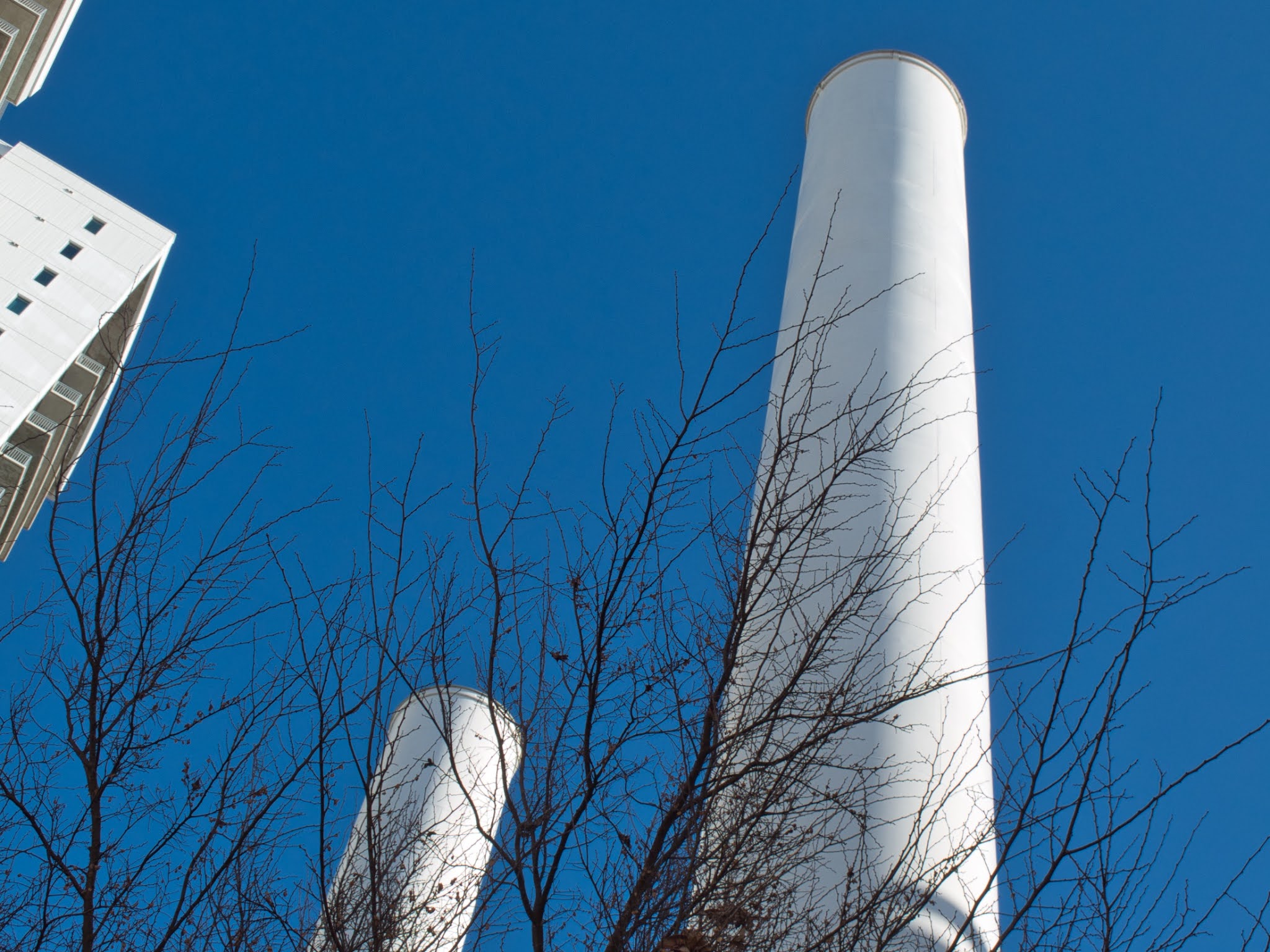


that 70mm focal length is nice to have. 
Yes, I know I can crop in post. I could macramé my own car seats too, if I had the inclination. 


Saturday, December 26, 2020

Walking downtown with Anne.

Anne.

Anne and I worked together for a number of years a couple decades ago. I had a commercial studio just east of downtown in a sprawling complex filled with ad agencies and creative types from every discipline. Anne worked as my photographic assistant and studio manager. She was, at heart, an academic and I loved it when she would correct my attempts to pronounce French words, or when I used an English word incorrectly. We had so many photographic adventures together that they all start to blur together.

At a certain point she had learned enough to go out on her own, and she'd heard all my lame jokes and stories too many times, so she worked hard to establish herself as a wedding photographer. She did well in that part of the business until the big downturn of 2008 and, seeing the writing on the wall, enrolled in nursing school at UT Austin and never looked back. She now has her masters degree and works in public health. 

But we developed a friendship back in the 1990s that's stood the test of time. We get together once a month when we can to drink coffee and catch up. I get advice from Anne, she gets to see what would have happened to her had she stayed in the photography business. And we're both unredeemable coffee snobs.

We used to sit in coffee shops for our chats but lately, in deference to Covid, we've been meeting at my favorite park. I bring the Adirondack chairs and she brings an endurance for my "wit" and ersatz conversation. 

We got in touch with each other last week to set a date for coffee and decided that today would work for both. But instead of meeting at the park Anne wanted to walk with me through "my" downtown. We made a plan to meet at Epoch Coffee which is just across the lake from Zach Theatre. She was on time. I was a few minutes late. She had a latté with minimal foam. I had a drip coffee with just a splash of cream.

As we walked along through the city I realized that walking in urban spaces isn't something everyone does! She hadn't been intentionally downtown in years. The profusion of new buildings surprised her. The clarity of the light was different than it is in the neighborhoods and suburbs. At some point it occurred to me that even the most observant and connected people mostly spend their time going to and from work, shopping for groceries and running errands. That walking with leisure through a space for no other reason than to observe and absorb the feel of the environment is a luxury that few people can do on a routine basis.

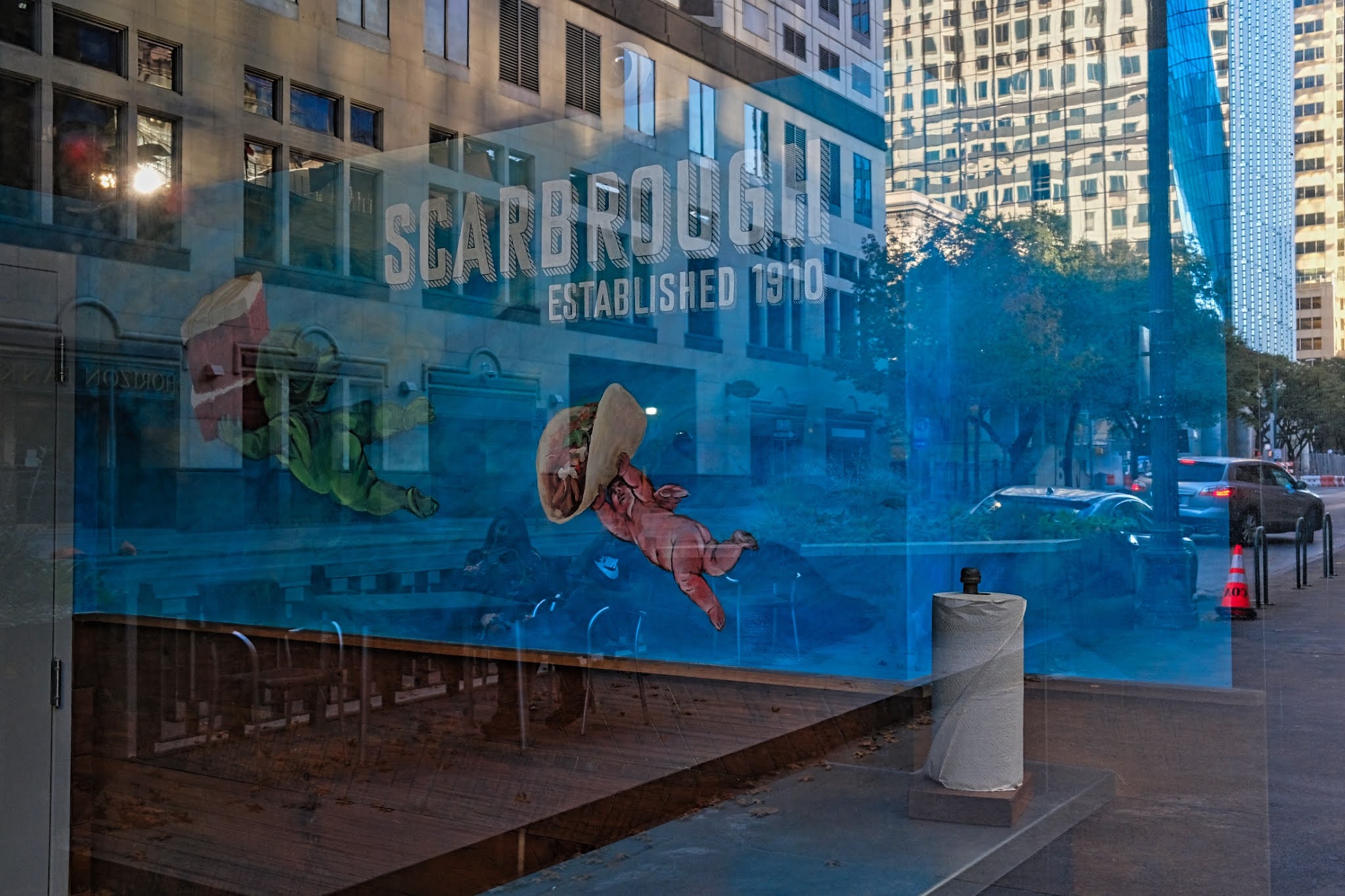
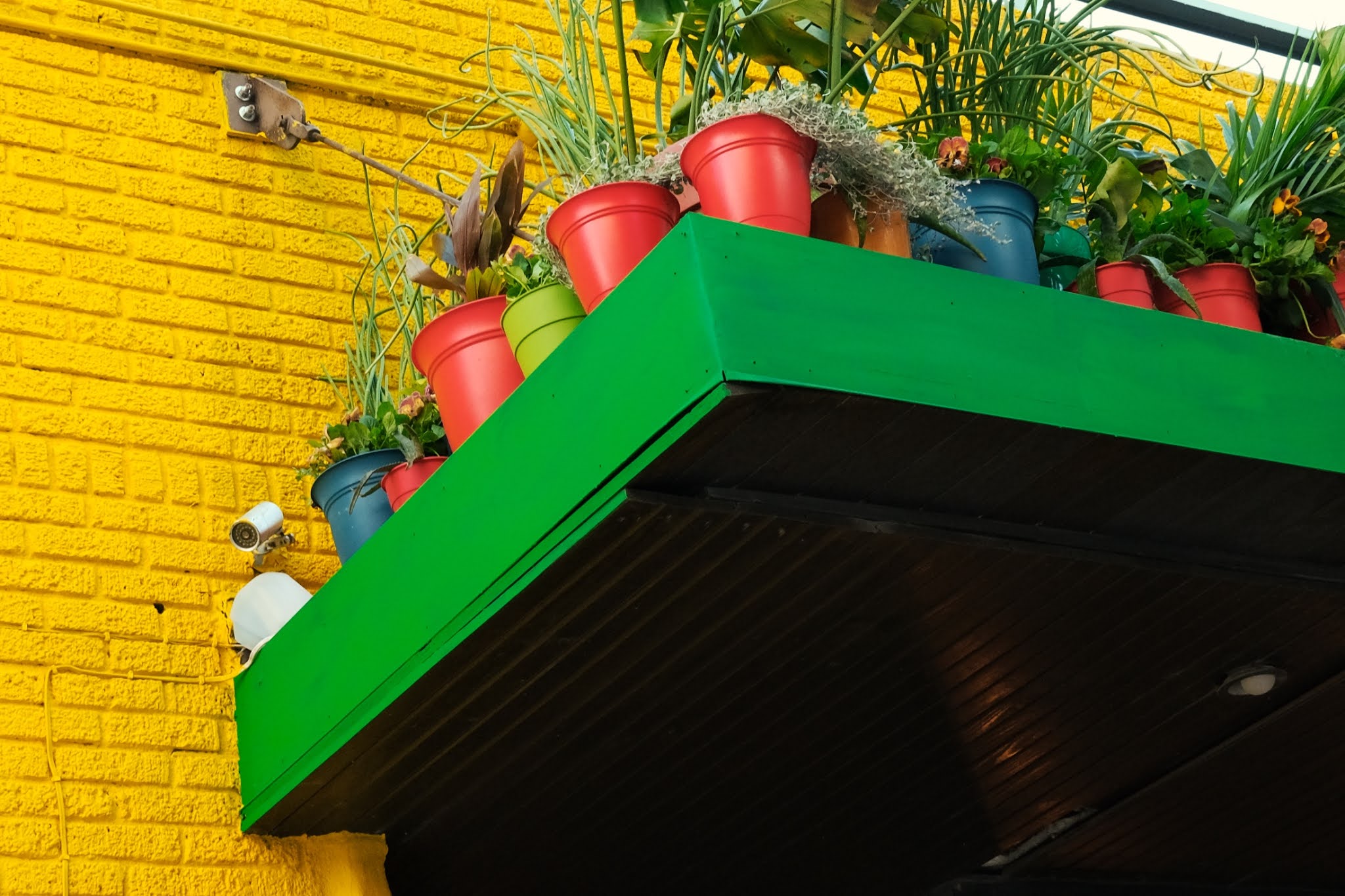
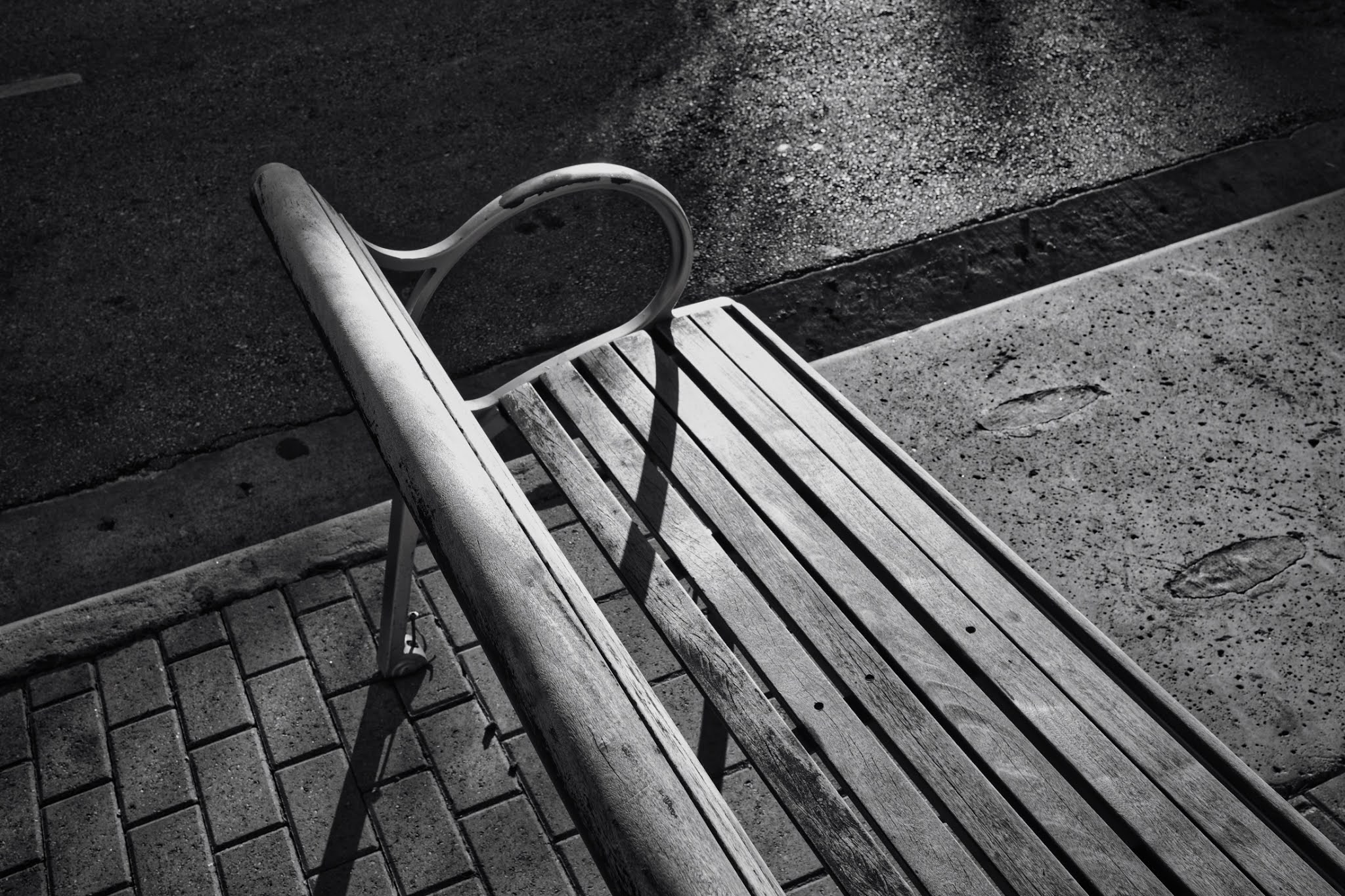
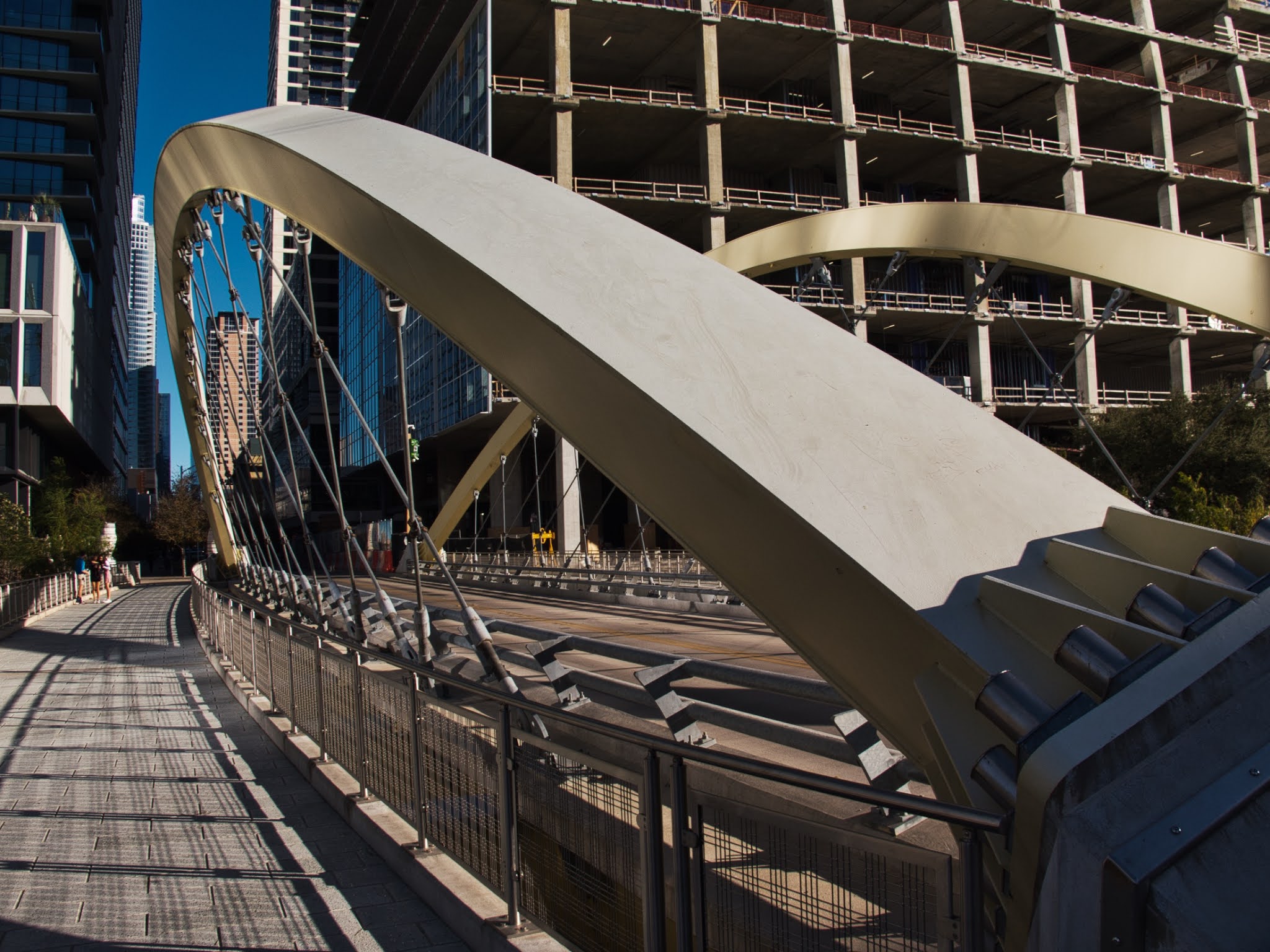
I carried the new Fuji X-100 V, which I am adamant I will master and learn to love; or at least like well enough. I took the image above over 20 years ago and it's one of my favorites. I took the photos just below with the new camera and they are over 20 minutes old.

Reflecting on my relationship with Anne over the past nearly 30 years makes it clear to me that a component of my work has always been a leisurely approach to each sitting. It's when I rush the process that everything falls apart. 

Our walk was well paced today. We stopped to look in store windows. I stopped to say, "hi" to a nice homeless guy I met when he was sitting on a bench a few weeks ago charging his collection of electronics. I am reminded that it's the act of walking that has the value, not souvenirs like photographs. That's a whole different thing.

the Fuji does 35mm.

the Fuji does 70mm.

the Fuji does 50mm. 

The image below is one I took a year or so ago, in my front yard. Anne needed a casual portrait for a work project and I was happy to try one. It was early evening in the Summer and the mosquitos feasted on our exposed ankles until we couldn't stand it any more and we retreated into the house.

I change camera systems a lot. I try never to change out friends. Especially superlative ones.

Anne.


Thursday, December 24, 2020

That weird feeling of looking into the gear cabinet and realizing that you've accumulated four Canon Powershot G series cameras. Along with a smattering of batteries. Time to take one mobile.

Here's a sticker on the plaza at the theater. 
The county has raised the Covid alert level to it's highest. 
The theatre was forced to shutter the rest of the holiday performances 
they were doing outside to comply. I hope 2021 is a year of 
recovery and happiness. 

Point and shoot cameras. Endlessly maligned. Now almost almost extinct. But why? And when did every photograph have to be taken with a full frame, state of the art, Uber-camera? I do my fair share of hauling around big cameras and bigger lenses but there is always a time and place for a small, efficient and highly portable camera as well. 

I have to confess that I have a soft spot in my heart for many of the PowerShot cameras that Canon has made, dating all the way back to the 4 megapixel G2 introduced back in the early digital ages. I find them to be the spiritual continuation of the most wonderful camera I ever owned; the Canonet QL 17. A wonderful film camera with a great 40mm f1.7 lens. Outfitted with a 36 exposure roll of Tri-X I always felt that camera was an extension of my own vision and not a separate tool.

Today, after trying to like a new digital camera for the better part of the week, I took a break and went out for a Christmas Eve walk around Austin with a "vintage" G16. Marvelous. And easy and competent. I felt like a beginner with a cheat sheet...


It's been a really nice evening. Belinda made au gratin potatoes and I grilled ribeye steaks. We made a salad of broccoli, kale and cabbage with a sprinkling of mixed nuts and dried cherries. Belinda made a chocolate torte. A good friend dropped by a bottle of Stag's Leap Cab. It was all delicious. Then we capped off the evening watching our favorite holiday movie, "Love Actually." It gets better every year.

Even on the years that are otherwise crappy. 

I hope you are happy, well, safe, in love, rich and beautiful. Even if you can check just a few of the blanks you'll be doing fine. The only important one is to be in love. Actually.