Thursday, April 13, 2023

Shooting outdoors with augmented natural light. Image created as a candidate for a book cover. The editors went in a different direction.

I was writing a book about some aspect of lighting and I decided to shoot a bunch of variations for possible book covers. I asked an attractive friend to pose for me. Since it was work I paid a modeling fee. This was exactly the look I wanted for the book cover but there is a tradition/precedent/agreement in book publishing that while the author has editorial control over the contents of a book, because the cover image is part of marketing for the project, the publisher has authority over the front and back covers. I'm sure if you are a super-hotshot-legendary novelist currently residing in Santa Fe you can make your own rules with the publishers but we newbies don't have that kind of power.

The subject of the chapter I was going to use this image as an example of was about modifying sunlight by using translucent modifiers. A fancy way of saying those pop up reflectors that allow you to take the covers off and shoot through white diffusion material. Cheap to buy and easy to use. 

I decided I should do this image exactly with the method I was writing about so I put up a 50 inch round diffusion disk on a stand between my model and a hazy sun. The image had everything I wanted to write about going on in it. Blonde hair for highlight detail. Jet black shirt for shadow detail. A great out of focus background.... just for the heck of it. 

The image was shot with a Nikon D700 camera using a 70-300mm f4.5-5.6 lens and just the diffuser on a light stand.  It's an image I was quite happy with. Nothing over the top. Nothing too dramatic and certainly  an image that would be easy to replicate for a reader of my book. 

I can't imagine that a current Leica or Sony camera, or a more prestigious lens would have given me better results. Sharper? Maybe but I think this one is sharp enough on the model's face; which is where I wanted the attention. More resolution? Sure. Maybe four+ times the resolution. But the original would fill a book cover with 300 dpi's of information so to what end? 

Image created on December 19, 2008. At 3:15 in the afternoon. Can't believe that was almost 15 years ago!!!

Just reminiscing while other people discuss monochrome cameras. I'll get around to that as soon as my Q2 Monochrom gets here.... gotta test these weird and off the wall conceptions of preferences for myself...

A Popular Question This Month From Blog Members is: Should I buy one of the Leica SL (original) Cameras? "I found one used at a good price..." My answer will be fraught with contradictions.


A bit of background: 
The original Leica SL digital camera is a weird one. Hold one in your hand and you'll immediately understand why so many people believe it is built to a much higher mechanical standard than anything else on the market; especially back around 2015 when it was first launched. It seems like it's carved out of a block of solid alloy, the buttons are perfectly positioned and weighted, the EVF is still highly competitive today,  and the thinner AA filter, fine-tuned to perform better with Leica M lenses on the edges (as compared with other brands' integration of the tele-centric nature of digital sensor with older, especially wide angle, lenses) made it Leica M user desireable. The last point, the Leica SL's sensor pack design was a big deal for people who already own, use and love Leica's vast line of new and used M series rangefinder lenses. Many people who adapted those lenses to other brands of mirrorless cameras found that sensor filters in most other new cameras were (and are) too thick and reduce the sharpness and contrast of M series lenses a lot. Especially in the corners. The SL was the first mirrorless camera I know of that worked at tackling that problem. 

And the fix doesn't just benefit Leica M lenses. There are numerous really good lenses that were designed before digital came along that have degraded performance when used on most cameras (because of the sensor stacks) but show huge "improvements" when used on an SL. Or an SL2 for that matter. This is why power users of legacy lenses and most M series lenses were interested in the first SL.

Added to that were the advantages inherent in a mirrorless design such as constant preview, fast frame rates, the ability to use a great EVF in conjunction with all different focal lengths and the ability to preview ones potential images right in the finder or on the screen. And the Leica color science.

The SL upped the ante with its build quality. It is one of the few modern cameras that can truly boast weather resistance and from one of the few camera makers to label the camera with an IP 52 rating. No guess work about reliability when it comes to dust and moisture intrusion resistance. 

At the time of launch it was a damn expensive camera, retailing for $7450.00 without a lens. In today's dollars it would be closer to $9,000. A lot to pay at the time for a camera which had few workable, full frame, L mount lenses available for it. That was a tough sell. Now the L landscape has changed. Between Sigma, Panasonic and Leica there are dozens and dozens of really great lenses available for the system. 

It's a great camera and, about a year and a half ago I bought two of them on the used market for about $1,800 each. Both cameras with all their boxes, packing materials and accessories. I wanted them originally as backup units for my then newly acquired Leica SL2 (current model). I didn't imagine that I would get much use out of them at the time but looking back the SL has been my most used and most enjoyed camera from 2022. The color is really beautiful and the files are sharp in a way that other cameras aren't. 

But would I recommend the SL as a budget entry into the L mount system for people who, unlike me, aren't besotted by nostalgia for all things Leica? Nope. Not really.

If I tossed off my history with Leica products (many M series rangefinders, way too many R series cameras and lenses, and several compacts) and just wanted to concentrate on building a workable and productive system around the L mount I would, today, go in a different direction. And I'll tell you why. It would be all about image quality, budget and the fact that camera body performance and value are two things that rarely improve from generation to generation. Nor does resale value.

If I were to buy today I might eschew both the low cost option of the SL (no matter how cool it really does look and feel) nor would I make the same choice I did and buy the SL2. Without considering budget I would instead lock in like targeting radar on the middle ground. The Leica SL2-S. It's the same rugged body as the SL2, the same menu interface, the same beautiful EVF, and even better color science. But available for about $2,000 less than the SL2 when purchased brand new. I have seen used prices lately as low as $3600. It's also been bundled with several different Leica lens options at prices low enough that you can end up getting the included lens nearly free. 

While the SL2 has 47.5 megapixels the SL2-S has only 24. But I see that as an advantage, not a detraction. In my experience too many pixels in a camera which does not have scalable raw file capability is mostly a burden. And since the SL2-S sensor is newer, and a BSI version, the high ISO performance is much better than its more expensive sibling. Finally, it's got great specs for video--- though I realize some of you think that video in a predominantly stills oriented camera is the Devil's Work. But all-in-all, if you are interesting in getting a Leica mirrorless, FF camera the SL2-S clicks every box. 

If I decided that I just liked the L mount system and the chance to use some of the great Leica SL lenses but didn't want to chase camera specs and obsolescence I'd make different different choices in 2023. If it came right down to it I'd be hard pressed to choose an SL over the Panasonic S5 or S5mkii unless I really needed the advantages provided to hard core M lens users. 

The S5 wasn't on the market yet when I started plunging into Leica L compatible cameras like the SL, the SL2 and the CL cameras. The Lumix S5 came along just a bit later and the S5ii  really just hit the consumer space last Fall. 

I did end up buying the original S5 at launch and, with the exception of the mid-level EVF resolution I've found the camera to be without many flaws, and none of the flaws rise to the worn and stupid phrase: Deal Killer.

If budgets were tight, or if I didn't give an armadillo's butt about the Leica Legend and the brand allure I'd skip the Germanic camera sculpture garden and go straight to a brace of S5ii cameras. On a tighter budget? Right now you can order the previous model, the S5, and get it bundled with a Panasonic 85mm f1.8 lens for the lofty low price of just $1497, new in a box with a USA warranty. 

The one disadvantage besides the loss of snob appeal of the S5 cameras is the lower res finder. But other than that, and maybe the depth of the sensor stack, there is nothing to complain about with the S5 cameras. 

It's a camera that's got the same basic sensor as the newest Leica SL2-S, the same general high ISO performance and it's smaller, lighter and, for most people, more comfortable to handle (size and weight+grip). You can also buy inexpensive generic batteries for the Lumix instead of having to splash out $285 each for Leica SL/Q2 batteries. And no generics are available for those pricy cameras. 

The S5 has a couple of other advantages over the Leicas but they are mostly features in the video space. The audio adapter for the S5 will allow the use of several XLR terminated microphones and will provide phantom power for professional mikes that need it. It's an amazingly good device for videographers. Especially the "one man crews." Oh, an if you get the newer model, the S5ii, you'll also get faster AF because ..... PDAF.

The other advantage comes from the camera's more parsimonious use of electrical power. Since it's not powering up a nearly 6 million dot EVF it doesn't suck battery power at the same rate. So the cheaper batteries also last a longer time. Bonus, bonus.

Choosing the right camera seems tough but if you are logical about decision making it's really not so hard. Once you get over the idea that you "need" a nearly 50 megapixel sensor you've won half the cost savings battle. Once you decide that you probably are never going to buy and use manual focusing M series lenses you can let go of the idea that you "need" a certain sensor stack of filters and color pattern arrays to get the best from your camera. Now you are free to choose the Lumix instead. 

Your rich Leica friends may tease you but your even wealthier banker friends will applaud your financial restraint over a piece of gear destined mostly to be used as a hobby device. In case you haven't heard, commercial photography is in the process of being cancelled altogether by our robot overlords. 

Doing it all over again? Two S5ii cameras. A smattering of the f1.8 Lumix prime lenses. The 24-105mm zoom and a hard stop. The reality? I'm not pressed to economize so I can buy with my emotions instead of my brain. With that being the case I think you can count on me to keep chasing the ever elusive "value" of the Leica brand. It's more fun for me. But that's probably material for my therapist (if I had one...). 

Bottom line? Buy what you can afford AND what makes you happy. Always good when those two parameters intersect where you want them to. 

Happy times.

Wednesday, April 12, 2023

Going back to basics. How I set up my camera for minimum surprises today. Brand and model neutral ideas.


Many years ago I had an epiphany about auto exposure and the quality of the resulting images. I'd been using what were state of the art cameras at the time (film era) such as the Nikon F5 and the Nikon F100 and using them in my favorite auto mode: aperture priority. I knew enough to tweak the exposure compensation if the tones in the frame were really light or dark. But back then, as now, I find that cameras are easily fooled by things like deep shadow or bright light sources. One of my more experienced (and wise) friends suggested an exercise for me. He told me to use a fully manual camera and to follow the Kodak instructions for setting exposures on that camera which were printed either on an inserted instruction sheet in each film box or as printed on the interior of the film boxes themselves. 

I found an old printed sheet for Kodachrome 64 (ISO 64) transparency film and I taped it with clear tape to the bottom plate of my old Leica M4. When I went out into bright sun the paper "meter" told me to always use 1/250th of a second f8.0 (or an exposure combination that equalled that EV). The idea being that if the light didn't change it wouldn't matter what tones were in the subject matter because the exposure was determined by the actual light falling on the subject. In bright sun it would always be that value! 

There are always caveats. The exposures were most accurate, depending on the time of the year, from about two hours after sunrise to two hours before sunset. There were other settings recommended for cloudy days, heavily overcast days and also open shade. All of them delivered fairly accurate exposures but the one for bright, direct sun with hard shadows? Always....right....on... the money.

I worked this way on one trip I made by myself to shoot in Paris back in 1988. I used the Leica M4 and a 50mm Summicron. I did not bring a light meter, instead I used the Kodak method. In the evening, when I switched to Tri-X film I used the exposure suggestions I found in the Kodak Photo Data Guide (which I still have --- in case I need to calculate reciprocity failure of 4x5 sheet film with long bellows extensions) which informed me that a good base for ambient fluorescent light was 1/60th of a second, f4.0. 

You realize of course that you can change the aperture and shutter speed to whatever settings you like as long as when combined they equal the same exposure value = EV. For example, if you'd rather shoot at 1/500th of a second you'd set your f-stop to 1/3rd stop less than f5.6. And Bob's your cousin. Or 1/1000th of a second with an f-stop of f3.5. Etc. etc.

When I realized that I didn't have to spend today waiting for the refrigerator repair person all day (that was yesterday) I happily went to swim practice and then, after a nice breakfast with B. I grabbed a camera that is fast becoming my favorite and headed downtown to burn off some of the stress of my ongoing "appliance trauma." Walking around with a nice camera and an empty mind was a good start toward calming me down and beginning the process of recovery from rampant customer (non) service abuse. Is the refrigerator finally repaired? Who knows? It's cooling now but will it maintain this level of performance after four or five days? History is bleak on this one...

But back to the photography. My biggest beef with modern cameras is their legacy of being confused by what I want exposed correctly. The cameras all want, in their own way, to analyze the scene through the lens, divide it into many squares, apply algorithms to the variance in the squares and then delivery a verdict. It can be a little off, a lot off or just wildly incorrect but it can be fixed by taking time to assess the image in review and then applying an informed amount of compensation, and then shooting again. That seems time consuming and burdensome to me when there are simpler and more elegant methods. 

With the Leica Q2 in hand I hurried to my reserved parking space near downtown, parked and then took a moment to set up my camera in a very old school fashion. I guess I should call it the Kodak Paper Meter Method to give some credit to the (once) Giant Yellow Father. This entails doing something you can do with any camera; modern or ancient. As long as you can control the shutter speed and aperture settings separately and manually. 

I set the ISO to the base of that camera. It's 50. It's not an interpolated 50 or a mythical 50. It's just 50 ISO. Same as on the Leica SL2. A third of a stop slower than the "real" ISO 64 found on the Nikon D850. The idea is to get the richest and most noise free file I can. Also to be able to  use middle and wider apertures without having to resort to an electronic shutter. 

I then set the WB to the "sun" symbol. Which, on most cameras, should give you a fixed color temperature of 5500 or 5400 Kelvin. According to all my tests and all my readings, as long as the sun is your primary source of direct light (not filtered through clouds) it will always be accurate. As in CRI 100. The sun is, after all, the gold standard. 

Then I set the shutter speed to 1/250th of second and the aperture to f7.1. I would have set it to f8.0 if I had been shooting at ISO 64....

The final touch was to move the camera lens from AF to fully manual focusing. On the Q2 you get hard stops at both ends of the scale. You get a very, very nice distance scale and a depth of field scale on the lens as well. When you focus manually you can set the camera up so that a touch on the focusing ring magnifies the center image for super fine focusing and, if you want it, you can also add focus peaking indications to the magnified image. Voila. Now you have a fully manual camera in every respect.

If you are shooting with the f-stop just shy of f8.0 and you are using a 28mm lens on a full frame camera you have a fairly deep depth of field and most of the time you can just "guesstimate" the distance and set it on the lens's focusing ring (unless you are cursed with a fly-by-wire focusing lens....and no manual clutch).  If you are diligent and you practice you can shoot with barely a thought lost to focusing. Or to spending the many hours of reading and trial and error you might have to spend to master some of the more "mystical" auto-focus modes in a modern "nanny" cam. 

If you've set everything manually you can essentially just point and shoot and be almost entirely certain that the shot will be technically perfect. This method does nothing to ensure that you've pointed your camera in the right direction. If you want a photo of the Beatles you have to be sure and aim the camera at the Beatles!

But there needs be no other thought process to slow you down. It's relatively fool proof. Even an Austin photographer can be remarkably (technically) successful with this methodology. Trying this doesn't require much diligence.....as most of these "straight out of camera Jpegs" can attest. The only alteration is a reduction of size so that I'm not uploading 50 megapixels files to the web. But I find this method heads and shoulders above automation in any brand camera if it's consistency and accuracy of exposures that you really want. Oh, and turn off dynamic range expanding options. If you feel that you really need them it's better for you to just shoot the files in raw and do that sort of expansion in post. At least there you'll have some modicum of control over the results. 

I walked. I photographed. I looked at distant objects. I cursed GE under my breath like a madman. And I tried to let the afternoon wash me clean like a fresh shower of sunshine and the detergent of a good walk. 

I think that falls under: "mental health" initiative. 

some captions below.  where I thought they were useful.


Spring time clouds in Austin are puffy, detail filled and have depth. Lovely.


I have shot the alley mural at Esther's Follies many, many times but the 
color out of the Q2 today was exemplary. This image is exactly as I saw the 
color with my eyes.....after taking off my Polarized sunglasses...


Not a particularly good image but a chance to use the Kodak suggestion for open shade.
I love the sign to the left of the door that commands a strict dress code. 
Especially in light of the place looking like a rat trap and also 
having a big ad on the wall for cans of White Claw. Pure class. 


the vertical sign used to be for a downtown department store called "Yarings."
the last downtown department store in Austin was "Scarborough's" but it 
shut down many, many years ago. In the early 1980s. 


I've been to Paris about a dozen different times, in all seasons, and I've 
never seen Parisian Women wait in line for anything but the rides 
at Euro-Disney. 


A "Made in Germany" ping pong table. Serious gear for a serious game.
I wouldn't go bowling unless I could get a German bowling ball. 
Precision engineering is important for games. 


the pyramidal steps of the Federal Courthouse. Surrounded at the bottom
by tent camping homeless all the time but I get run off when I climb the steps and
try to photograph the building. Often by men with firearms, poor educations and bad manners. 
If I set up a tent out front I believe I would be free to spend all the time I ever wanted to tunnel into the building. But why? And what Netflix show will use this as a plot line?

Russian agents or Republicans bent on disrupting justice by living as homeless people in tents, 
spending night and day to tunnel inside.  My bet is on the Russians as the republicans would most likely get lost or sidetracked by the soft drink and candy machines in the basement.
Not political just observed behavior reporting. 


 In my experience Austin is one of the few downtowns in which food can be delivered from multiple restaurants for in-office lunches and can be reliably left outside the front doors of a bank building awaiting each customer's pick up of same. Well, here and in Tokyo...


That's all I've got today. I'm setting up an SL2 and a 58mm f1.4 for evening photos.
Still using the Kodak Photo Data Guide for a starting point. 

Tuesday, April 11, 2023

I'm beginning to realize why it is I like older, manual focus lenses. Even if I have to use adapters to get them onto my current cameras.


Modern, fly-by-wire lenses have a uniform fault. From my Leica 24-90mm zoom lens to my 35mm f2.0 Sigma, and just about all of the other AF lenses put on the market since AF became de rigueur all share the same fault, regardless of brand. They have no hard infinity stops, no depth of field scales and (most grievous of all) they lack distance scales. You literally can't "zone" focus them without having to pay a lot more attention to the process than you should have to. There are a few modern lenses such as the Pro S series from Panasonic and the Pro series from Olympus that have auto focus to manual focus clutches. Pull back on the focusing ring and voila, you are bequeathed both hard stops and also a distance scale. A big and accurate one. But modern lenses with this capability are rare. And not always in the focal length range you might desire.

One of the things that draws me to want the Voigtlander lenses I have been buying is just this thing. A repeatable and knowable distance setting feature for all of the manual focusing lenses. It's a godsend. 

I made the photograph above on a shooting trip to Rome. I was using a Mamiya 6 camera which makes photographs on 6x6 cm film. As with any larger format camera the depth of field is less than what we are used to when using lenses with the same angles of view on smaller format cameras. But even with a slight telephoto lens on the camera I was able to select a focus distance and understand what kind of depth of field I would have before even lifting the camera to my eye. In the days of zone focusing we were generally pretty good as estimating distances. 

I can't remember whether or not I just took one frame of this scene on the Spanish Steps or if I had time to tweak focus with a second frame but I was able to work quickly, nonchalantly and without the intercession of AF. And once you've focused well the lens maintains your setting whether you keep your finger on the shutter button or not. Once focused you are ever-ready...until the distance changes.

When I take one of the 40 or 50 or 58mm lenses out with me on a digital camera I always feel more in control over the entire frame when the lens I've selected is an "old school" prime with a great depth of field scale on it. If you haven't tried this way of shooting you might want to put an older, manual focusing lenses on the camera of your preference and give it a go. It could be a perfect way of working for you. 

Disregard if you are shooting football with long lenses... 

It's funny that in the old days, the days of ASA 400 Tri-X film I didn't really pay much attention to depth of field. When we were photographing in old book stores I defaulted to f1.7 on my Canonet camera because.....I kept running out of light.


And now it's a look I find wonderful and fascinating. Along with that 40mm focal length. 

Funny how, until recently, need was the mother of style. We needed more light. I opened up the aperture knowing I was hitting the limits of my ability to handhold the camera. But to my eye the out of focus areas in the background, as authentic as they come, make this portrait of a young child clutching a print magazine one of my favorite early photographs. I think I've been trying to get back to that basic level of making pictures ever since. 

What Now?


It's gloomy out there on the web. At least it seems to be for people who are interested in photography. I just read that Thom Hogan of Bythom.com is taking a month off. Maarten Heilbron, whose camera reviews on YouTube were always fact-filled, fact-checked and fun to watch has thrown in the towel on making camera reviews; mostly because the major camera makers have stopped spending enough on marketing to even be able to send out review cameras to reviewers. Not as give-aways but as temporary loaners. Maarten's post from a couple of days ago is entitled: "It's Over."  Of course there's the big story about DP Review shutting down as well. 

Many of our favorite bloggers who wrote about photography and cameras seem to have aged out, or run out of steam and inspiration. Topics skew far afield and little nuggets of good, insightful information abut photography have become harder to pan for than gold. 

I find blogging is widely devolving into a cult of personalities in which the writers' life and life stories are given much more emphasis than the topics we originally sought them out for. Yes, it's nice to have well written articles but even better when they are on subjects we're interested in. 

Both Thom and Maarten provided numbers or anecdotal information about the overall decline of the camera markets and, by extension, the world of the profitable practice of photography. From them as well as other sources I think we can agree that at least in the short term the outlook is bleak. Especially when measured by camera sales...

The ever-growing and deeper piercing nail in the coffin for most photographers with a certain tenure in the market is generative A.I. If you think it's kludgy or not ready for prime time you need to step up your research a bit and I think you'll see that, in capable hands, the technology is going to be is devastating for professional photographers. The taking of headshots, product shots, and most lifestyle advertising will vanish as jobs. Or projects. Or sources of income. All that will remain are folks content to sit in front of computer monitors carefully describing what they want the robots to make for them. And, when it comes to commercial work, why not? Clients always seem to know what they want. Their accounting departments are loathe to pay humans for silly stuff like.....art. And making up whole worlds on the fly is a heck of a lot quicker and infinitely cheaper than sending out a human to do their best with reality. Fantasy is much more addictive and hence much more lucrative for advertisers. No cameras or shoe leather required.

I remember watching a movie in the 1960's called, "Jason and the Argonauts." It featured lots of stop frame animation and claymation. Those were primitive visuals and yet the audiences went right along with the action. Now we can drop a computer generated stand-in for Carrie Fisher into a Star Wars movie ("The Last Jedi") and not even be able to tell that the moving image of her character is totally CGI. No suspension of disbelief required. Seamless --- and at thirty frames per second.

We don't have to dislike or renounce photography to grapple with where we are at this point in time. When the gear talk goes away so will community. There is no future in writing about the philosophies of picture taking. Why? Because as much as people profess to want access to such material only a tiny handful will really read it or search for it at all. How do we know? Because the internet has tested that for decades. We love to talk about gear. We are bored talking about aesthetics, or any non-mechanical process. 

I know you're tired of hearing about my fucked up refrigerator and the ongoing saga of corporate incompetence. I know most of you couldn't give a rat's ass about my ability to swim or the happiness I derive from it. And seeing yet another tranche of images from Austin's downtown is just depressing. It's the same for me on other blogs. Snooker? Breathing machines? Vegan-ism as religion? About as interesting to me as the nuances of the competitive flip turn are to you. 

So. What now? Without a ready market camera makers will slow down new product introductions. Eventually Fuji will make sure everyone who takes photographs with a dedicated camera has access to a Fuji X100V and will then probably shut down. Why bother after full saturation?

Some kids will mine the used market for rangefinder, film Leicas for the next few years and walk around in the street shooting with 28mm lenses until the last sources of 35mm film dry up and the labs close down. A few people who lack other talents will doggedly soldier on over at YouTube to make walk-and-talk videos about whatever new cameras or old news comes their way. But everyone is seems to be moving on, ditching photography as we've known it and replacing it with automatic content from their phones. 

Seems like the perfect time to retire. 

Here's my current plan: I'm 90,000+/_  page views away from my content here having generated 30,000,000 page views. That's measured by Blogger and not including stuff you read on an RSS feed. Add in those numbers and it's several times more. But I can only measure what I can measure. When I hit thirty million page views I'll take a big long look at the trend lines and if they are, as I predict, falling off a cliff I'll take note, sign off and leave the web to the last few, standing and producing photography experts.

I figure we're about a month away from the target date. I won't see it as a defeat if I decide that we're done. I'll see it as the turning of a page and my adaptation to human evolution ( or de-evolution). But I will say one thing. Now I understand how newspaper editors, writers and photographers felt as the ground slipped out from under their feet. 

One thing I'm going to do over the next 30 days is to write only about photography, cameras, lights and lenses. I'll try to give the blog a fighting chance at relevance. Wish me luck. 
 

Sunday, April 09, 2023

Easter is a time when we just photograph everything at f2.0. Okay...we can also use f1.4.


B. is in S.A. taking care of her mom. The refrigerator is still broken. No swim practice on Easter. The pool is closed. It's overcast. It's the perfect day to roam around downtown and play with a new lens.

I rounded up a spare battery, plugged the Voigtlander 58mm f1.4 lens onto the front of a Leica SL2, ditched my cellphone into a desk drawer, double-knotted my walking shoes and headed downtown. My intention today was to photograph everything I wanted to photograph while doing it in black and white, at ISO 50 and with the lens spot-welded at f2.0. I gave myself permission to try some shots at f1.4; just to see how it might work out. 

If you are of a certain age you probably remember the Easters of your youth in the same way I do. All the stores were closed. All the churches were open. Some families dressed up with the little girls in pink dresses and matching shoes and the boys looking uncomfortable in hand-me-down jackets, choking-collared white shirts and clip-on bowties. Other families looked out the window at the earnest church-goers going by, with shaky dads holding the curtains open a bit with one hand while nursing a hangover with a can of beer in the other. 

I had to go to church back then because my father played the organ there. He didn't really believe in any of the religious dogma but he loved wailing away on the big organ just behind and to the right of the pulpit of the church. We sat bored and uncomfortable, feet unable to reach the floor and looking vaguely forward to a nice brunch at a restaurant with white tablecloths, extra forks and spoons,  tuxedoed waiters and an older African American man in a black suit playing "Alley Cat", "Mack the Knife" and other favorites on a much smaller organ. A restaurant sized organ. We got to order hamburgers and french fries. The grown-ups got shrimp cocktails with cocktail sauce, and then steaks. 

At some point in the day either my brother or I got in trouble for drawing pictures of the Pillsbury Dough Boy with captions that read: "He Has Risen." 

It all seemed so innocuous back before the far right started weaponizing religion again... Funny that "Happy Holidays!" is now a call to arms... so sad. So misguided. So....off message.

Sunday morning in Austin was quite different today. In fact, it seemed like just another day in a (cloudy) paradise. Torchy's Tacos was open so I was thrilled to get a bacon, egg and cheese breakfast taco and a coffee there. The restaurants were open up and down Congress Ave. and also Second St. The homeless on the streets were a deep contrast to the well dressed crowds hustling by on their way to hotel restaurants for Eggs Benedict and Mimosas. And the weather over all was comfortable but gloomy. 

I walked through downtown with the camera over my left shoulder and my sunglasses hanging off the collar of my black shirt. The one with the demure Nike logo on the front.  I was interested to see how the lens performed when I used it close in and wide open. Seems pretty nice to me. The contrast there is a bit low but that's why Adobe invented the contrast slider and the clarity slider in Lightroom. If you can correct for geometric distortion and vignetting in the camera's firmware  is it any more "cheating" if you correct the contrast in your software?

I didn't stay long. I made a loop through the parts I thought might be interesting today and then headed back to the house. I was on a mission. I'd volunteered to bring along two nice bottles of white wine to have with fish at a friend's house later this afternoon and it dawned on me that I needed to chill the bottles and.....no refrigerator. In 2023, in an age of endless affluence, I actually had to go to a convenience store and buy some ice with which to chill the wine. Savagery. Despair. 

To sum up: The re-delivered lens is great. That and the 40mm are a fun pair. Not having a functioning refrigerator has moved from being annoying and frustrating to being an interesting experiment in adaptation. With luck and lawyers the fridge should be fully restored by Tuesday. The lens doesn't need any repairs which is enough to currently endear any device to me. Car, camera, lens, water faucet.... If it works I'm a fan. 

It's a weird holiday for me this year. Usually spent with family. Not this time. But it's good to have friends. The more the better. And I'm avoiding Peeps this year and embracing Cadbury Eggs instead. It's part of my theologically inclusive Easter diet plan. 

It's not as much fun searching for Easter eggs if you have to hide them from yourself, for yourself.... Just a thought.


A quick note. I'll leave it just as a headline. I want to thank everyone who commented this past week. It made writing blog posts fun, happy, rewarding and comfortable. We don't always agree but if we did there would be no sense reading it. Right? Thanks!!!


Saturday, April 08, 2023

I guess this week's fascination is with products from Voigtlander. At least that's what I'm currently interested in....


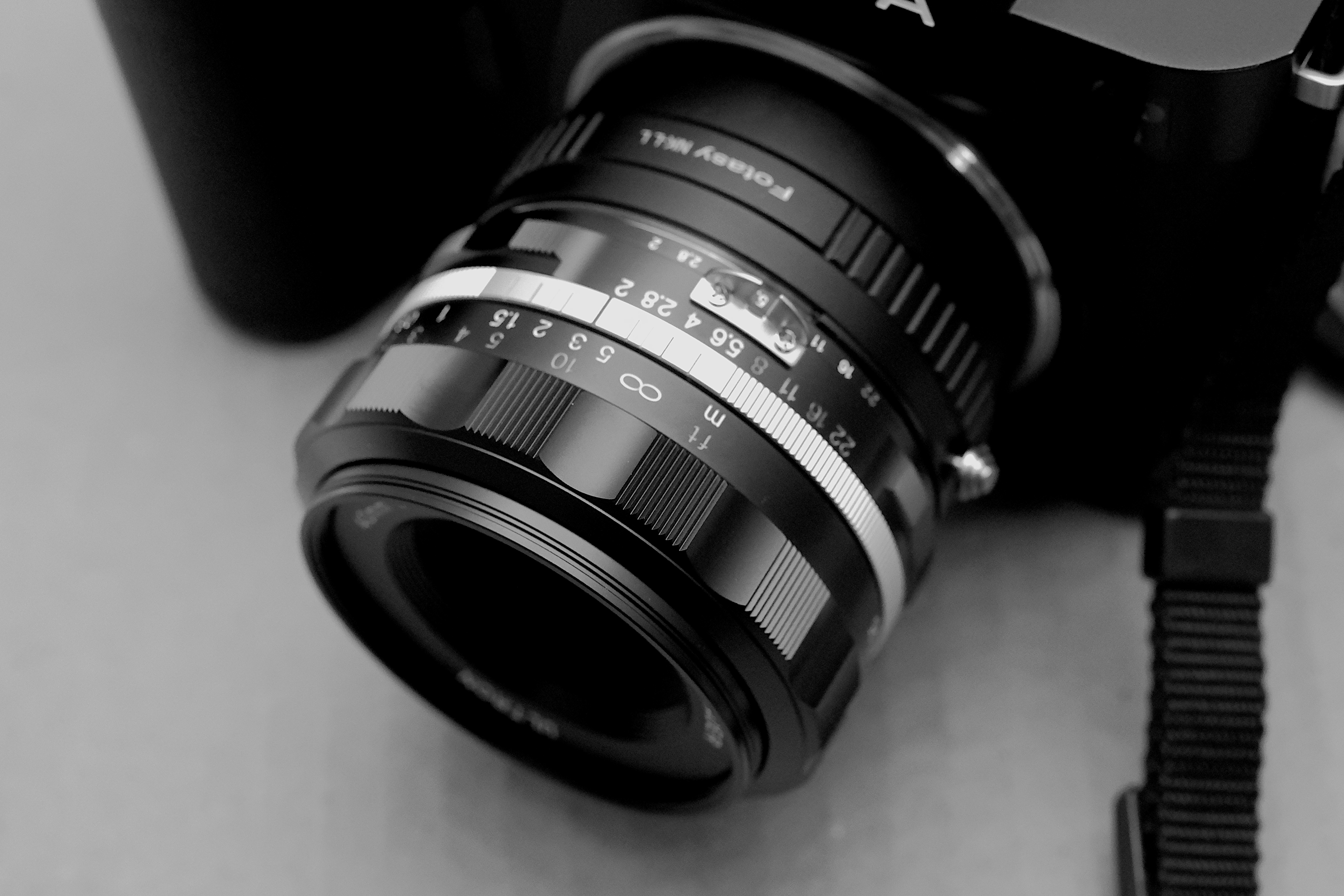
The nicely recessed front element largely eliminates the need for a lens hood. Maybe. 
One standing by, just in case. 

Lenses seem to be this month's fascination. I can't imagine a better camera for me than a Leica SL2 so I've given up even reading camera reviews --- by anyone. This has allowed me to concentrate more completely on the most fun part of photography gear, the ever interesting subject of camera lenses! 

The current fascination mostly started on a lark. I was looking at L mount lenses at B&H's website with the idea of finding a small, light, cheap but good lens to take with me on a vacation to Vancouver last November. I didn't like the options I found for the L mount; or I already owned a number of them and was looking for a different set of compromises... whatever reason I stumbled across lenses over in the Leica M mount section. That was okay because I knew I could adapt any of the M lenses to the L mount with a simple adapter. 

I found a lens that was small, fast, reviewed as being sharp and interesting, and available, on sale, at a very affordable price. It was the 40mm f1.4 Nokton Classic, with multi-coating (apparently, if you like flare and some additional artifacts some Voigtlander lenses are available in a single coated version....) and it was priced at $399. It came in a classic M lens configuration with cams for rangefinder coupling and the cool little finger grip for fast focusing. I bought a lens hood and a B+W filter for the front (knowing I'd be out shooting in the rain a lot) and I took that lens with me as my only lens, paired with a Panasonic S5; the "early adopter" version, not the S5II. 

I shot a couple thousand frames with the lens and really liked the way the files looked. There is a bit of uncorrected barrel distortion and the usual vignetting one sees from most fast and wide-ish lenses but for the most part it was great --- easy to focus and tiny. There is one fault with my copy that would have been a catastrophe for an M rangefinder user who doesn't test gear before traveling with it. The focus calibration is pretty far off. What that means is that when the lens hits its hard stop at infinity it's focused far beyond infinity (if that's theoretically possible) and what you gain past infinity you loose in close focusing capabilities.  Oh, and the marked distance versus the focused distance are two wildly different settings. Used on a rangefinder you would always be focusing well behind your subjects. No big deal on a mirrorless camera. One of the charms of the mirrorless tech. 

The one aspect of the 40mm lens I really liked was, in fact, the focal length. Nearly 45 years ago, when I was just a photographer child I scrimped and saved and bought a Leica CL. Not the digital one, obviously, but the original. It came with a 40mm f2.0 Summicron C lens. The lens was superbly sharp. Far sharper than any lens I had ever put on any of the Canon cameras I had been shooting for a number of years. I loved the lens and the focal length and could kick myself, hard, for ever selling it. But I had yet to gather my "extensive fortune" by that time (still trying). And so the lens went on the chopping block to pay for something else. But I never got over that focal length. It seemed, in some ways, so "right." 

This Spring I realized that I had hit a milestone and, in the Leica cameras I'd acquired, I'd found a system that I haven't felt the least bit of motivation to move on from. Or to add to; camera-wise.  I felt a stability creeping into my viewpoint on cameras that I hadn't felt for a long time. But as the desire for new cameras faded my brain compensated by increasing my desire to track down the "perfect" lenses for me. Not for you, or the sports photographer you know, or the photo-journalist you read about. Just the perfect lenses for me.

Unlike Leica, Sigma, Panasonic and others Voigtlander is not concentrating on making ultra-of-the-moment, best-in-class lenses. They don't make autofocus lenses, nor are any of their Voigtlander branded lenses featuring stuff like image stabilization. You have to focus by hand. And learn how to hold your camera and lens nice and steady. But what they are making is a collection of lenses that I would label: Romantic. 

By romantic I mean that they provide a visual profile that's more similar to film era lenses than to the highly corrected lenses being made for digital. The centers are quite sharp at the first few apertures on the lens but the corners are much less sharp. The lenses's optical designs are simpler and the corners get nice and contrasty, sharp too, as one stops down toward the middle apertures. The lenses I am interested in are so similar to early, all metal Nikon lenses when it comes to dress and construction. And, incidentally, the lenses in which I am most interested are the ones that are currently (still?) available in the Nikon F mount. 

I experimented with my friend, Paul's nearly brand new Voigtlander 58mm f1.4 lens last month. At the time I thought the Sigma Contemporary series 65mm f2.0 was so close in focal length and so much better an all around performer that I would pass on Paul's offer to sell me the lens at a most advantageous (to me) price. But over time the samples I shot with that Voigtlander 58mm lens have grown on me. Made me realize that I grew up and learned my craft at a time when these lenses, or lenses like them, were our aspirational tools. I loved re-connecting with the feel and the visual structuring of this type of lens when I revisited the 58mm in March. 

Last week I took delivery of a brand new Voigtlander 40mm f2.0 Ultron SIIs. It's the latest permutation of that lens, evolved over time, by the company, and looking so much like a metal focusing ring Nikon 50mm F lens from the 1960s. Even down to the "rabbit ears" aperture grabber on the aperture ring (used to connect to pre-AI camera metering systems from the middle ages of photography). 
 
A couple of days ago I put up a quick gallery of images I shot with the lens on my first foray out with it. It balanced nicely on the front of an SL2 and I liked the images a lot. You can see them here: https://visualsciencelab.blogspot.com/2023/04/stuff-photographers-worry-about-that.html just scroll down past the "gray space" (type). 

My takeaway is that the lens does a lot of stuff just right. The focal length is between the 35mm that most prefer and the 50mm+ that I'm used to. It makes this lens wide enough to capture environmental portraits without a lot of elongation of noses or novel recessions of ears, etc. while getting enough of the background in to make an interesting image situated --- somewhere. The lens is quite sharp in the center of the frame which works well for portraits (and most other subjects) and then field curvature makes the far edges and corners less sharp and more nicely out of focus. Stopped down to f5.6 it's as sharp as anything I own. 

The 40mm Ultron is currently available in a Nikon F mount for around $419 USD. I think it's a good value for the price. And my success with the 40mm pushed me to go back and look at samples I shot with the 58mm. In retrospect I like those images a lot. Especially the combination of the color and contrast; even with images done at the maximum aperture. Can't wait to try it out as an APS-C portrait lens on a CL.

I texted Paul today to ask if he still wanted to sell his 58mm. He was game. I asked why? He liked the lens so much that last time I was playing with it he was pretty sure I would want one and so, when he found a copy in just as good shape, and for a great price, used, he bought it as well. Now he's got two and I got the feeling that he was holding one back for me until I came to my senses and just bought it. We've both been buying and selling lenses to  each other for about 25 years. I think he's got a good intuition about what I will eventually want to own....

In about an hour we'll meet for coffee at our favorite coffee shop. I have already written out a check for him. Sorry. No Venmo here. Just old school banking. We'll compare notes about life and work and then I'll leave with the 58mm, bring it home and put an adapter on it. Tomorrow I'll go out with the 58 or the 40 and spend some time playing around. It'll be a nice change since it feels like it's been raining for a month here and the weather is supposed to start clearing up. 

Now, why the Nikon mount? Well, I look at it as today's universal mount because the flange distance is long enough to enable one to mount it on just about any mirrorless camera being made right now. Were I to suffer a severe concussion, wake up and for some reason want to buy a bunch of Sony A7xxx cameras I could use any of these current F mount Voigtlanders on those "cameras" just by switching out inexpensive adapters. Another reason is that these two lenses, as far as I know, are only available in Nikon F mounts or Pentax K mount versions and I'm thinking the Pentax mount is part of an ever shrinking market. Getting adapters for Nikon to L mount is simple right now --- not so sure about Pentax to L mount...

That's all the lens news I have for today. Stay tuned for a gallery or two of the results from both. 
Resoundingly old school. Maybe bordering on "ancient school." 

A "re-print" of something I wrote for Michael Johnston's "TheOnlinePhotographer" twelve long years ago. More appropriate today that it was at the time. And tangentially the subject of a recent series of columns. Enjoy?! From 2011.

To see the original with photos and comments appended, go here: https://theonlinephotographer.typepad.com/the_online_photographer/2011/12/kirks-take-kirk-tuck-2.html#more                             

Action vs. Activity. One makes you an artist,
the other makes you tired.

By Kirk Tuck

Action and activity are two very different things and it's important for an artist to know which one they're focusing on. Action derives from need or reaction. You are hungry so you eat. You need to get somewhere quickly so you walk faster. You need to get warm so you head for shelter. You have a vision you want to interpret as a photograph so you do the process of making that photograph. You are pushed to eat from necessity and you are pushed to create the photograph by necessity. One driver is physical while the other pursuit is driven by passion. Both are pretty unencumbered pathways and both have an immediate aim. Eating gives you the fuel to go on while creating art gives you the emotional fuel to enjoy life.

Compare honest hunger with a more common variation: Eating because you are bored. Eating because the food is in front of you. Eating because you want to keep your hands busy. And, eating because the taste of whatever you’re eating entertains you. In this sense eating becomes an activity instead of an action. And activities are the biggest time wasters in our lives.


As photographers our focus should be on the making of images. But that's hard work. Even if you are hungry to make an image, there are all kinds of impediments. You might have to find models or subjects that truly resonate with the vision you have in your head, and you'll have to find locations and you might even have to get permission from a property owner to make your image on their property. But if you are really driven to make the image and express your art you'll find a way to channel the resources and the energy. If you are committed to expressing yourself and sharing your interpretation of the world around you then you'll punch through the mental and rationally-based "resistance" to actually creating art, and you'll get your project done. That's action. It comes from a need: the need to express your art. The action fulfills the need.

And if you practice your art with a focus on the action you'll find that it becomes less and less scary to pick up the tools of your art and head out the door to just do the process. But...some of us get trapped by one or more of the insidious spider webs immobilizing us from taking the right action. We get stuck in one of the levels of hell that I call "Endless Preparation." It's also known far and wide as "Research."


For photographers endless preparation begins with the selection of camera gear. As rational, educated and affluent adults we move in a world of bountiful information but we’re not always good at asking the right questions or divining the right answers. In fact, we focus so narrowly on some parameters and not at all on others. We've been taught that good preparation is paramount for any successful mission and we’ve taken that to heart. And so we begin the first part of the journey into the sticky spider webs of rampant indecision and quantitative ambiguity.... I’ve been doing it all month. I would be better served inviting my quirky and interesting friends into my little studio and making their portraits with whatever camera and lights I already have, but...shamefully, I've allowed my subconscious resistance to getting that project started push me into the un-winnable endless loop of trying to decide which little mirrorless, compact camera deserves my true affection. Will it be the Nikon V1 or the Olympus EP3? And, of course, it doesn't matter which decision I make because I'll end up using it for casual work and not the work that really motivates me to create my own personal art. But I've already wasted plenty of time shooting with both cameras and then writing down and sharing my observations. In a sense I'm also guilty of enabling other would be artists' progress by inferring that the issue of picking the ultimate "little camera" from a "moving-target" list of camera is an important and valuable consideration. Which, of course, it's not.

And even though my mercurial and unstable selection processes are becoming (sad) legend among fellow photographers, I find it hard to resist. Just like everyone with a facile and functioning mind, I've found that my subconscious can rationalize the hell out of just about any equipment "research" and acquisition. The latest is a little voice that says, "The art of photography is getting more fluid and fluent. We’re capturing sequences and interlacing it with video and all the presentations are going to the web. We need small cameras that can capture both quickly and easily. The small cameras with fast processors are the equivalent magnitude of destructive innovation engendered by the screwmount Leica cameras of the 1940s and early 1950s." Hell, given time I'm sure I could rationalize selling my car and buying all the small camera models.

You may laugh at my personal quagmire but I see variations in and among my friends and colleagues and all over the web. You may be the kind of person who finds the activity of researching and testing small cameras lacking in restraint, but your "activity" might be endlessly profiling your printer, your monitor, your camera, your wall, your light stands and so on. While my wasted time is spent comparing reviews and specifications of delightful neckwear bling, your wasted time is spent scanning and shooting Greytag MacBeth color targets and "mapping" them to some new paper from Croatia. It’s really the same thing. It's a preparatory activity that's powered by the rationalization of mastery, but it's really just a strategy to procrastinate from dipping a toe into the unknown.


I also have a friend who is really a good photographer who has been on a relentless workshop circuit. If someone's offered a workshop somewhere on the web he's probably been there and taken it. And yet what each workshop offers is a new set of technical skills that he feels he must master before he heads out to do his "real work." But since there's an endless supply of workshops, and a nearly endless reiteration and repackaging of techniques, he's mostly ensured that, without some effective catharsis, he will never really get around to doing the work he envisioned when he first became entangled in the sticky webs of photography.


If the activity that fills your nervous void is something like eating or smoking, chances are you will either become very large or very sick. But if your activity is the research and mastery of every corner of our craft, you will become an expert in arcane lore and analysis and a pauper in creating and sharing finished art. And there's is no law that says you can't make that choice. But so many of us are so well trained in debate and rationalization that we suppress a reality that we should at least give a passing nod to. In some ways my own blog tends to enable the endless search for endless things for which to search. But it sounds preachy if I tell everyone to stop reading and contemplate what it is they really want to say with images.

So, what am I getting at? Well, I'm trying to become a "recovering" researcher in my own work and I've made myself a little checklist to work with. I’ve set some ground rules to keep myself within the design tolerances of sanity. We'll see how well this works out....

Kirk’s Rules of choosing Action over Activity:

  1. It's okay to buy a new camera, but I am required to go out and shoot fun images with it for more time then I spend writing about it or measuring its results.
  2. It's better to shoot images that are fun, make you laugh and make your friends happy than images you think will impress other photographers. Even better if the images can work in both camps.
  3. If there's no reason for me to be out shooting I can default to a nap on the couch to replenish my body and spirit. Sometimes pushing myself out the door is just the wrong move.
  4. If I catch myself shooting test charts I stop immediately and head out the door with a good book. Or a camera.
  5. The feel of a camera in my hand should always trump someone else's written evaluation. No one really knows how I want things to look.
  6. I have a post card sized white card pinned to the wall behind my computer that says, "Making Portraits is my Art. Anything else I do is not-art."
  7. Quiet contemplation is more conducive to having fun ideas than relentless study.
  8. All the things I really need to know to create are already locked away in my brain, I just need to be still and quiet enough to open that door. Sitting quietly beats looking at DxO results for thinking about creativity.
  9. Inspiration comes to those who leave space for it to come in. A busy mind usually lacks the space.
  10. I have a smaller card tacky waxed to the bottom edge of my monitor that says, "To stop suffering stop thinking."

And therein lies the real secret roadblock to all creativity...at least for me. We spend far too much more time thinking about our art than just doing our art. Being smart is highly overrated because it requires us to do too many mental exercises to prove to ourselves that we should be doing what we already know we want to be doing. And the process of rationalizing and the desire to master each step is the process of not doing the final step. The "going out and shooting."


The photographic process (in a holistic sense) works best for me when it works like this: My brain comes up with an idea for a visual image. (Not the overlay of techniques but the image itself ). I quickly decide how I will do the image. I go into action and book a model or call a likely subject. We get together and I try to make my vision work. Within the boundaries of the original idea we play around with variations and iterations. Finally, the photo session hits a crescendo, and the subject and I know we've gone as far as we can, and are spent.

My years spent as an engineering student taught to be logical and linear, but have been my biggest impediment to doing creative work. Because there's always a subroutine running that says, "This is the step-by-step approach to doing X." And I'm always trying to approach things logically. But to get to X is hardly ever a straightforward process and being able to step outside routine and to stretch past logic creates the time when fun stuff happens.

Beyond my ten steps to choose action over activity is the realization that I already know enough technical stuff to last a lifetime. And, if we admit it to ourselves, the technical stuff it the easiest part to learn because there are no immediate consequences to learning or not learning the material. Really. You might waste a bit of time and money but for most of us that's about it. The hard part is being brave enough to stake out a vision and work on it. The hardest part for most of us is to continually engage the people around us that we want to photograph and convince them to collaborate in the realization of our vision. But it's only through doing it again and again that our styles emerge and our art gets stronger. The technical stuff is so secondary.

As an exercise, when I'm out walking around with my camera I make it a point to approach a stranger each time and ask them if we can make a portrait together. If I get turned down, I approach someone else until I find someone who's willing to put a toe across the fear line and play. The image isn't always stellar. Hell, it's rarely great work. But it gives me the practice and the tools to abate my fears so that when the right muse comes along I am ready and willing to give it my best shot. Practice doesn't make perfect. Practice frees your art. Relentless activity depletes that same energy like air escaping from a balloon.

I hope you'll accept what I've written here in the spirit I've intended. We're all on a journey to amaze ourselves. The first step is to choose action over activity.

And by the way...there is no ultimate camera choice.

Kirk