Wednesday, July 26, 2023

Changing gears for a day. After the studio shoots I'm cycling back to a smaller, handier camera for a spell. Blame Robert Frank.

too many gadgets? The hand grip, the thumb grip....

Here's the "stripped down" version:

Less comfortable. But less bulky.

The purist's configuration.

Have you ever clicked on to a documentary about a favorite photographer and, when the show finished you were ready to adapt his style for your own work? I've always enjoyed the work of Robert Frank. I think his photography is direct and fearless. So I was happy when someone sent me a link to a documentary with and about Robert Frank, on Amazon Prime video. It's called "Don't Blink." 

The video was done in 2015 and Frank was, at the time, in his late 80s or early 90s. He was still quite sharp, irascible and opinionated. In part of the video he was walking around on the Coney Island beach and reminiscing about a series of photographs he'd taken there 50 years earlier. He had photographed strangers on a beach packed with people and his photographic efforts went on all day and into the night. 

In this scene he talks about using a small and discreet camera and moving quickly. Shooting quickly. As he's talking about this the video camera pans to a young, current-day photographer walking around on the beach with a big DSLR, big zoom lens, big camera bag hanging off the shoulder/back. Sticking out like a huge, sore thumb. And Frank remarks that to get the images he wanted when he shot there he had to be less obvious. Less plodding. Less stiff. He had to move fast and carried only one small camera and lens.

Through the video the only time a camera is in the frame it's a small screw mount Leica camera with an equally small 35mm or 50mm lens on the front. That's it. No zooms. No light meter.  No telephotos and (obviously) no special mirror gadgets involved.

Watching the video triggered for me a memory from an earlier time in my non-linear progression as a photographer. I was working as a copywriter for an ad agency and my passion was photography. At the time I was using an ancient Leica IIIf screw mount camera. A camera model that dates back to the early 1950s. A time before the M series Leicas were introduced. 

I was always working on a budget so I rolled my own film with a bulk loader. Always Tri-X. And when using those earlier Leicas you had to trim the leader of the film in a certain way if you wanted the film to load and advance properly. Scissors were a necessary accessory. Always. Probably the sole reason I first bought a Swiss Army Knife. Always having scissors in my pocket. 

One week I took a break from work. It must have been in 1979. I was at my parent's house in San Antonio and itching to go somewhere out of the country, to have an adventure and take photographs. This was long before I was married. Long before I had any sort of responsibilities. No constraints on my time.

I packed a few pieces of clothing in a small backpack, dropped all of my gear (one Leica IIIf, one 50mm f3.5 collapsible Elmar lens, my Swiss Army Knife and twelve rolls of hand rolled film + a passport) into a small shoulder bag. A repurposed, non-photographer bag. And asked my older brother if he'd drop me off at the San Antonio airport. This was a time in which one could arrive at the airport, look around at the various destinations on offer right now and be on an airplane heading somewhere within a half hour. Security check? Didn't exist.

The destination that looked best (and cost least) was Mexico City. I paid $36 for a plane ticket and headed out. I arrived at the airport in Mexico with no hotel reservations and no real plan but I'd read about a hotel on the Zocalo (main square) and it seemed interesting so that's where I headed. I spent a week going to markets, the park, the pyramids outside of the city, the Zone Rosa, the Anthropology Museum and even the National Pawnshop. I had a wild breakfast one day at Sanborn's House of Tiles and walked without fear or trepidation through the downtown  a couple of nights at two or three in the morning. 

My constant companion was the tiny Leica rangefinder camera. So many good memories even if the photos I took were less than spectacular (no light meter, still learning to print, still learning my way around composition). It was the process, the time spent, the adventure that made the trip an important one for me.

What an interesting time. No cellphones. No internet. No credit card. No schedule and no fear. Just one very small, very rudimentary camera and  the desire to make photographs. To see things. Heaven.

So this morning when I woke up I was still thinking about Robert Frank, photographic adventures, small cameras, discreet photography and thinking....even if "discreet" isn't the pressing issue, how much fun it was to travel so unencumbered. So light. So quick and so free.

I had a camera in mind today that I thought I'll circle back to. It's the small, handy, Leica CL. The digital one. That and the smallest modern lens I could find. The little Carl Zeiss 28mm. It's like a 42mm (short normal) on a 35mm camera. The camera is also just about the size of the old IIIf...

I set the camera to shoot black and white. I'm enthralled with it. But mostly as a symbol for adventures. So much history calling out to photographers....

And here I am getting ready to shoot a portrait in the studio with a big MF camera. Odd times.

Would there be a market for a camera like the ancient Leica IIIf I shot with? No frills. No automation. No huge size. No high value. Just a lens, a shutter and a sensor. Not even a light meter? I'd buy one. But then I'm eccentric enough to part with the cash...  You?


Tuesday, July 25, 2023

Out of practice. Like running a race you haven't been training for....

For visual pleasure only. No connection to the written content below...

I got a couple emails from a large radiology practice I've worked for often during the last 20 years. The emails came in last week. The requests were for two portrait sessions. Two doctors are joining the practice. The practice currently has about 150 doctors/partners and I believe that I have made portraits of every single one of them. Now we'll add two more.

As I opened my calendar to schedule the new doctors' appointments I realized that the last time I accepted an real, commercial assignment to make photographs was on June 15th. Back then I photographed five people for a public relations agency. Coincidentally, they sent me their selects to retouch as I was typing this blog post.

So it's been a month and change since I've done a job for a client. Sure, I've been keeping in practice operating cameras and, with a little help from my swim friends, I've been keeping my personal portrait "muscle memory" up to date. But I'd almost forgotten all the small details I have to put together to produce even the simplest of productions. 

Both of my portrait sessions for the radiology practice are booked for tomorrow. One at 11:00 a.m. and one at 5:45 p.m. It's nice to be able to schedule both on one day as I'll only need to set up the background and lighting once. 

I have a list from my adult supervision department. They (B.) indicate that it would be nice to have everything on the list done before the first person arrives in the morning. That list includes: cleaning the bathroom (including cleaning the Saltillo tile floors), stocking water bottles in the fridge to offer on client arrival, sweeping the walkway to the studio door, vacuuming the studio, maybe cleaning the studio windows, picking up all the extraneous gear littering the studio floor and otherwise making the compound look welcoming and.....aesthetically....satisfactory. 

In addition I have a self-generated list of items that includes: Setting up the portrait lighting I designed for this client a while back. I donated all my AC powered strobes to a newly launched photographer earlier in the year and am just using three Godox AD200 Pro flashes for all my flash work. 

Two of them go into the Godox mounting bracket that conjoins two bare bulb flashtubes and provides bright modeling lights. These, as one unit, will go into a 50 inch Octabank/softbox. I have already charged their batteries and tested them with an appropriate trigger. The additional AD200 Pro will be used with a round head and a dome diffuser to illuminate the background --- which will later be dropped out in post production.

I've now set up and tested all three lights. They work. Hooray.

Since I'm thinking of the Fuji MF camera as a personal/art camera for now I was hesitant to use it for these paying jobs but I thought, "oh, what the hell?" and decided to give the new camera a go. I set it up and finagled all of the settings required to work in a studio electronic flash environment. I also set up the camera to shoot Super Fine Jpeg + Raw so I can shoot the portraits in a square format and crop down to final, vertical images. The Jpegs will show the 1:1 crop but the Raws are there as a safety net in case I really screw something up and need the assistance of reliable and forgiving raws. 

One benefit of a square file mentality is not having the need to turn the camera sideways to get the usual vertical portrait shot. So much easier to work with a horizontally configured camera and just to crop as needed.

The other big set of tasks is just the straightening up of the studio and the putting away of all the toys that I've taken out over the last few weeks to play with.

I guess the biggest thing is actually accepting the idea that I have to knuckle down and actually be here at an appointed time. Or, rather, two appointed times. Other than swim practice I haven't had "time certain" commitments for weeks on end. I pretty much get to do whatever I want to do whenever I want to do it. 

Two studio portrait in one days feels like baby steps. Baby steps away from the edge of being fully retired. Which I've already decided would be too boring to actually consider. 

But I'm still happy I turned down the 14 shooting days in Houston the first two weeks of August for a London agency. That seemed a bit too hot and intense a re-entry to enjoy.

Swimming. The one thing I have been diligent about this year has been swimming, and the related strength training I've added mostly in service of improving my swimming. 

The water was cool enough this morning to swim more distance sets. The core of our workout today was a set that consisted of some middle distances --- reps of 200 yard swims. 

I call it "middle distance" but world class competitors now see 200 yard swim races as sprints. 

We did 400 yards of swimming and 400 yards of pulling, along with 200 yards of kicking, as our warm-up this morning. The fun, overarching set was:

4 x 200 yard swims on a 2:45 interval. The intention of the coach was that we "descend" each 200. Starting at a moderate pace and swimming each successive 200 faster until the 4th one was more or less a 95% effort sprint. 

Followed by a six minute continuous recovery swim.

Then 4 x 150 yards swims on a faster pace; still descending all four.

A recovery swim.

Then 4 x100 yard swims on 1:30 with each one being a faster sprint than the one before it.

We wrapped up with a moderate 400 yard cool down swim. 

There are two things I can feel improving in my stroke because of the strength training at the gym. One is that I am swimming while holding my core (ab muscles) tighter. Same with my gluteus muscles. This is an aid to maintaining a streamlined body position in the water. And as we all know better streamlines are "free speed." 

The second thing is that I've really been studying Katie Ledecky's distance freestyle stroke and trying to adapt a longer reach and a better turn over cadence while swimming freestyle. Katie just tied Michael Phelps for the most International Gold Medal swims (20) so she's the perfect role model for anyone trying to improve their freestyle swim performance. In the 1500 meter race held yesterday in Japan she beat her closest competitor by 17 seconds!!!!!! Amazing. All Hail Katie Ledecky. 

The biggest take away I've found so far is to start my catch way up at the front of my stroke instead of just leaning into the middle of the stroke for power. Try it. You'll find more power throughout each arm stroke. And it's the strength training that's providing the extra power at the front end of the stroke. I can actually feel that.

I'm trying to stay on the topic of photography here but swimming is just so captivating. Check out the World Swim Championships races on YouTube if you get a chance. Do a search for "Leon Marchand breaks Michael Phelp's record in the 400 I.M." It will make you a swim believer. Far more exciting than any "team" sports/games. Infinitely more exciting than watching bowling, golf or snooker... And over much quicker as well.


back to work on the studio prep. Hope your day is more fun.


Sunday, July 23, 2023

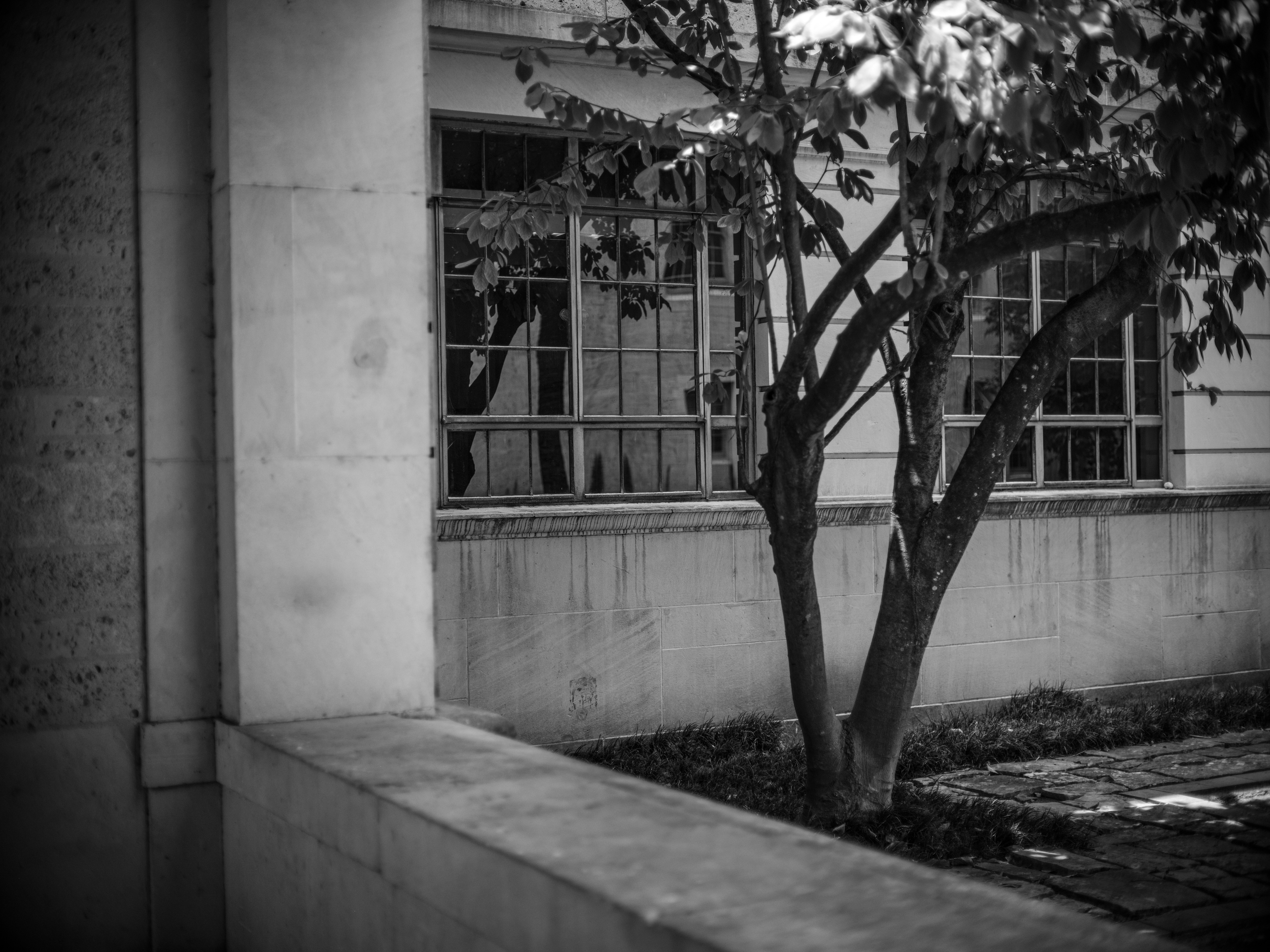
Cross format compatibility. Will a Voigtlander Nokton 58mm f1.4 SLIIs Nikon mount lens cover the full frame of the medium format Fuji 50Sii? Let's walk around during the heat of the day and find out...


Walking around the West Campus area and walking around on the University of Texas at Austin campus.

 At least on campus there is ample shade....

When I got the Fujifilm 50Sii from my friend it came complete with a Tech-Art Nikon F to GFX lens adapter. Just so happens that I have two Voigtlander lenses in Nikon mounts; the 58mm f1.4 Nokton and the 40mm f2.0 Ultron. Both are very, very good lenses when used for their "native" format = 35mm. I wondered if either of the lenses would project a big enough image circle to actually cover the full width and height of the 33mm by 44mm sensor in the MF camera. 

Today I decided to find out. Well, I decided to find out how the 58mm performed. I'll try the 40mm next time.

Here's the TB:DR (too bored, didn't read) version: The lens has a very small but very severe bit of vignetting in all four corners. I'd be more concerned if the vignetting occurred in just one corner...or two. Stopping down makes the vignetting smaller in size but denser in its core. Focusing close reduces the size of the vignette. 

At wider apertures the corners and about 5% of the edges of the frame are soft. Stopping down to f5.6 the whole frame (except for the far corners) gets nice and sharp. I think it's a laudable performance since we're using the lens here far outside its design parameters. For portrait work it would be fine. Hate the vignetting? A slight crop into the frame will fix that right up. 

The focus peaking in the Fuji 50Sii works really well. The lens focuses really well. I am now considering adding the 90mm f2.8 Voigtlander lens in a Nikon mount to round out the mix. Nothing certain yet. Hesitating because I know myself and if I end up liking and keeping the Fuji I'll probably go out at some point and buy the vaunted 110mm f2.0. But with my luck I'll decide to make the purchase the day after it goes off sale. If I push "buy" today it's $2200. If I wait it will be four or five hundred dollars more. Another first world dilemma to worry about...

Still f-ing hot here. Not getting better. Cabin fever sinking in every day after lunch....

Take a gander through the images. From what I can see both the camera and the lens are worth having. Keep in mind that my intention is to use the Voigtlander 40 and 58  (and other 35mm format lenses) with the camera set to the square format. In that configuration there is no vignetting and no noticeable softness in the corners.  Yay!


Saturday, July 22, 2023

Boxes. Boxes. Boxes. What do you do with all the boxes?

 A friend who buys many cameras and lenses keeps every single box. If he buys a battery charger and it comes in a box he keeps the box. Lenses? He keeps the boxes. Cameras? He definitely keeps the boxes. I used to keep camera boxes because I thought it would enhance the value of a camera when it came time to sell it or trade it in. But eventually the store I did a lot of trades with stopped keeping the boxes of cameras that were traded in. And that meant that when buying used cameras from them there was never a box. No instruction manuals (those are mostly online now) and no paper errata/trash. 

A couple of years ago I looked in a closet in my studio and there on the shelves was a chaotic collection of boxes. I started throwing them all out. Recycling the cardboard and recyclable materials. I figured there were some cameras I was going to keep for a long time and hoarding boxes just didn't make sense. 

Then I started buying Leica stuff and I noticed that the several Leica stores I buy stuff from seemed to charge more money for cameras that were: "In box." or "Boxed." Sometimes a couple hundred dollars more than for cameras that were sold "naked." 

Recently I bought a camera and lens from the same friend mentioned above. At the time of our transaction he arrived with a shopping bag that had the box for the camera, the separate box for the lens, and even a box for an after market battery charger. All the boxes were in pristine condition. All the paper trash included.

So, my question to the VSL braintrust is: Keep or throw? How do you handle the pile of boxes that tend to be accumulated over the course of time? Do you have a methodology? Is it something like: Camera boxes=save, lens boxes=toss, accessories=toss. ?

Are you pickier? For instance, do you save lens boxes if the lens is over a certain price? Do you toss lens boxes for "ordinary" lenses? What's the dollar amount cut-off? Do lenses over $1,000 get to keep their boxes? More? Less? 

All these empty containers take up space. Do they really have value or are some Leica buyers deluded into thinking that every scrap of Leica gear they buy will one day become a high value collectible which will increase in worth if accompanied by the box? 

Why would Sony buyers even consider keeping a box? What about the cheap, Chinese lenses? Do we save those boxes? Something as rare as a Pentax box I could see.....maybe.....

Help me make sense of all this!


On a more important topic.... I read last week an interesting article about strength training that ran in the Washington Post. Apparently the way many people lift weights/do resistance work is more a tradition than a science. In a study researchers found that instead of doing short reps (five or less) with heavy weights --- right up at the level at which you can't lift the weight one more time --- is no more effective at building strength (as opposed to muscle mass) than doing more reps (more comfortably) with lower weights. Lower being a weight that you could lift say 25 times in a row without hitting your point of failure.

The later method is more comfortable for most people who just want to put off sarcopenia and gain the health advantages of increasing strength (weight loss, balance, mobility, etc.). The traditional method of trying to lift the heaviest weights you can for a handful of repetitions has only one "advantage" in that it builds muscle bulk to a higher degree.

I guess that's cool if you want to look ripped, pumped up and more like Arnold S. But you trade off flexibility when you add too much muscle. 

I knew this info would be important to you. If you are so inclined be sure to look for the original source article in last week's Washington Post. 

Swimmers don't need bulk. They need strength and flexibility. Less weight x more reps seems to be the way.

Same for photographers.


Friday, July 21, 2023

Photos of Kirk by Gordon Lewis.


©Gordon Lewis

Gordon proves that Kirk is capable of smiling in a photograph. Is not mean. Is not dangerous. 

We were having a coffee here in Austin and from time to time making images of each other. 

©Gordon Lewis

It is rare that I am photographed by anyone except myself. I had no idea I talk with my hands so much. And I'm happy to see that I like the way my new glasses look. Time to stop dying my hair and beard white. I should let the natural, jet black hair color show through... (wishing). 

©Gordon Lewis

©Gordon Lewis

Why now a beard? Hmmm. Laziness. A lack of shaving motivation. As a shield against UV exposure on my face? I lost a bet? The beard creates drag while swimming so it adds to the intensity of the workout. I'll shave just before the next competition and it will probably take seconds off my time (more wishes...). 

I can't remember what I was talking about when Gordon took these photos but in the very last one I think it looks like I was saying something profound. I was not. Sadly.

Thursday, July 20, 2023

Testing the (relatively) new Fujifilm GF 35-70mm f4.5-5.6 zoom lens. Works fine....


I got the Fujifilm GFX50Sii with one lens. It was the 50mm f3.5. It's a really great lens. So far I like every photograph I've made with it. Well, I mean I like the technical qualities of the lens but maybe not always the subject matter. But so many readers and friends emailed me after finding out that I'd stuck a whole foot back into the Fuji camp to tell me just "how great" and "what a bargain" the "kit" lens was that I just felt dumb not acquiring it immediately. Turns out that my friends were right. It's a fine lens. Even though it's slow it's very sharp and seems perfectly corrected. No stumbles on focusing and no artifacts that I have to work around. 

Much as I like futzing around with cheap, all manual lenses I have to admit that it's nice to have lenses that autofocus and can be used with all the autoexposure programs on one's camera. For outside use, on a bright, sunny day with a visibility of 28 miles, I'm using f8.0 as my go to aperture. That's nice and sharp. The first image (top) was shot at f11. That's sharp as well. 

The 35-70 is a collapsible lens; it trumpets trombones in. That makes it smaller for times when you want to dump the whole rig into a camera bag. There's a big warning on the LCD reminding you to extend the lens when you turn on the camera. There's not much else to say about it in particular but I do have one thought about "testing" short range zoom lenses. 

It's this. There is a psychological tendency (at least in my brain) to shoot images at both the widest zoom setting and the tightest zoom setting, of the same subject, to see if one angle of view works better than the other. Kinda dumb since I already can see that I have a preference for the middle ground. But as you look through these pix you'll find some "sets" of images shot from the same spot but with one at the wide angle setting and one at the telephoto setting (if you can call 50mm 'telephoto'."). 

These images were submitted via email the Tate Gallery and the Museum of Modern Art. They were roundly rejected. But at least the MOMA sent a nice note along with their 'cease and desist" notice. They said, "Only William Eggleston and Stephen Shore can send us boring test shots and expect to get this kind of banal stuff exhibited. But we admire your courage in actually sending along this crap...." The note was unsigned. Oh well. I gave it a shot. I'll see how it does on YouTube....

35

50

Happy Aspect Ratio. Happy focal length. 


Some day in the future someone will think this is an interesting relic of the late 2010s. 


35

50


a shutter speed fast enough to stop a fast moving passenger train. 
But the train was actually standing still....

All images are straight out of camera jpegs. 
Nothing fancy here. 

After endless hours of deliberation I've decided to keep the lens.

It's fun to meet up with people who read my blog. We both brought cameras. I had a wonderful afternoon coffee with Gordon Lewis.


I was determined to get out today and take some more photographs with the new camera. I know that sentence sounds like something you've probably read here a hundred times... "Kirk wants to try out his 'new' camera." I'm referring this time to the Fuji GFX50Sii. I've taken it out for a short spin before but this time I had the new 35-70mm zoom lens on it and I wanted to see how it would all work.

But, of course, it's not the lens I used to take the two portraits here....that would be too easy.

So, I headed downtown and snapped a bunch of familiar scenes. I usually don't carry my phone with me on walks but B. was driving back from San Antonio and I wanted to be available if she had any troubles on the highway. I checked the phone every once in a while and the last time I checked I had a text from a number I didn't recognize. 

Usually I trash texts from unknown numbers but the text was written with nuances of familiarity. I remembered that my friend and blog reader, Gordon Lewis was supposed to be in town this week so I queried back: "who?" Got an instant reply. Yep. It was Gordon. He wanted to know if I had time to meet up this afternoon. I'm nothing if not spontaneous, and Gordon is fun to hang out with, so of course I immediately accepted the offer.

I dropped by the house, changed lenses to the 50mm f3.5, hopped in the VSL staff car and headed over to meet Gordon at a restaurant where he was finishing up a lunch appointment. We both agreed that it was too hot to walk around and take photographs so we decided to find a nice, cool, coffee shop. 

After a moment of deliberation I decided to take us to my local coffee place; Trianon Coffee. It's at the end of my street. I spend a lot of time there. Mostly goofing off. 

When I have coffee with people who are smarter and more interesting than I am I try to remind myself to stop talking so much and listen better. Gordon has been a professional photographer and is now focused on being a professional writer. He knows stuff that I don't. 

We talked a little bit about cameras and photography. More about music and a good deal about life. I had to drop him off over at the University of Texas after coffee. He had another meeting. But he made two hours of conversation go by in a flash. I was a little sad when he got out of the car. Kind of like when you see a good movie and then it's over and you have to exit the theater into bright sunlight but you wish the movie had lasted just a little longer.

He took some photos of me. I hope I get to see them. If they make me look at least 10% better than I do in real life I'll be sure to post them here... with Gordon's permission. 


Gordon Lewis. At Trianon Coffee. Austin, Texas

Fujifilm GFX50Sii + 50mm f3.5

#funstufftodoinaustin